Futsal began as a five-a-side experiment in a Montevideo gym in 1930, and it ended up shaping the Brazilian players who redefined soccer. Nearly a century later, 232 teams from ten Canadian provinces and territories entered this year’s national championship. Here is where the game came from, how it actually works, and where Canada fits into it.
On April 12, 2026, a Toronto club called 9 de Octubre beat Atlético Gatineau at a sports complex in Calgary to win the Men’s Futsal Canadian Championship, a rematch of the previous year’s final, which Gatineau had won 3-2. Down the hall, Sporting Montréal FC beat Saskatoon Green & White 4-0 to take the women’s title, completing something no Canadian club had done before: national championships in both divisions of the same sport. Few readers outside the game will have heard of either club. Fewer still will know that the sport traces back to a YMCA gymnasium in Uruguay, or that its most famous alumni include Pelé and Zico.
Where futsal actually came from
Futsal was devised in 1930 by Juan Carlos Ceriani, a teacher working with YMCA youth leagues in Montevideo, Uruguay, according to a history published by U.S. Futsal and corroborated by the sport’s Wikipedia entry. Uruguay had just won the inaugural FIFA World Cup that same year, on top of Olympic soccer gold in 1924 and 1928, and young players wanted a version of the game they could play on the courts they already had access to, rather than full-size pitches.
Ceriani borrowed rules from several sports already popular in gymnasiums: five players a side and match length from basketball, goalkeeper handling rules from water polo, and court and goal dimensions closer to team handball. A formal rulebook followed in 1933. The game spread through South America over the following decades, and took particularly deep root in Brazil, where, according to the same history, a generation of players including Pelé, Zico and Sócrates first developed their close control in futsal before moving to full-size soccer.
How futsal differs from 11-a-side soccer
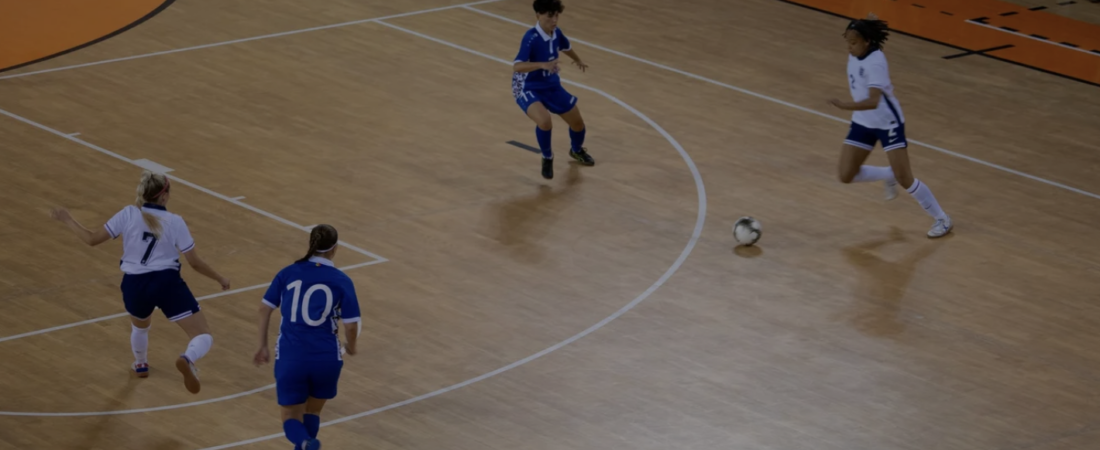
Futsal is not indoor soccer, even though the two get confused constantly. It has its own ball, its own court markings and its own rulebook, maintained today by FIFA. The differences change how the game is played, not just where.
| Feature | Futsal | 11-a-side soccer |
|---|---|---|
| Players per side | 5 (1 goalkeeper) | 11 (1 goalkeeper) |
| Standard court/pitch | 40m x 20m, hard court | Roughly 105m x 68m, grass |
| Ball | Size 4, 62-64cm circumference, low bounce | Size 5, higher bounce |
| Match length | Two 20-minute halves, clock stops on dead balls | Two 45-minute halves, running clock |
| Substitutions | Unlimited, rolling, up to 9 subs available | Limited (typically 3-5 per match) |
| Offside rule | None | Applies |
| Restart after ball leaves court | Kick-in | Throw-in |
Table: Raw POV, compiled from FIFA’s Futsal Laws of the Game and Wikipedia’s futsal entry. Not published as a single comparison by either source.
The lower-bounce ball and tight court reward close control and quick passing over long balls and heading, which is the technical case historians of the game make for why it produced so many Brazilian standouts. FIFA has run its own Futsal World Cup since 1989, and Brazil has won it six times, in 1989, 1992, 1996, 2008, 2012 and 2024, more than any other country. Spain has two titles, and Argentina and Portugal have one each.
Futsal in Canada: from two teams to 232
Canada Soccer’s domestic futsal championship is younger than the sport by decades. The men’s edition launched in 2015 with just two clubs, from Quebec and Ontario, playing at a community centre in Outremont, according to the championship’s history as recorded on Wikipedia. A women’s championship followed in 2023.
The 2026 edition, held April 9-12 at the Seven Chiefs Sportsplex in Tsuut’ina Nation near Calgary, was the tenth. Calgary United Soccer Association hosted in partnership with Tourism Calgary, the third time the city has taken on the event. Canada Soccer reported a record 232 men’s and women’s teams entered provincial and territorial qualifying, representing ten provinces and territories, before eight men’s clubs and nine women’s clubs advanced to the national finals. Matches were broadcast live on FIFA+, and roughly 475 fans attended the men’s final in person.
The 2026 finals, in numbers
| Men’s final | Women’s final | |
|---|---|---|
| Result | 9 de Octubre (Toronto) beat Atlético Gatineau; goals for Toronto from Joshua Paredes, Christian Samaniego and Raheem Rose (final score not published by Canada Soccer) | Sporting Montréal FC 4, Saskatoon Green & White 0 |
| Tournament MVP | Christian Samaniego, now a five-time national champion | Shayla He, hat-trick in the final |
| Notable | Rematch of 2025 final, which Gatineau won 3-2 | Sporting Montréal’s first women’s title; club also holds two men’s titles (2017, 2022) |
Table: Raw POV, compiled from Canada Soccer’s match reports. Toronto’s goal count reflects the scorers named in Canada Soccer’s own recap, which did not publish a numeric final score.
Sporting Montréal’s sweep made it the first club in the competition’s history to hold national titles in both the men’s and women’s divisions at the same time. Samaniego’s fifth title, split between two clubs, Toronto Idolo Futsal (2018, 2019) and 9 de Octubre (2023, 2024, 2026), points to how small the competitive scene still is: the same handful of clubs and players keep meeting in the same finals, even as the qualifying pool has grown into the hundreds.
Canada’s international futsal breakthrough runs through Latin America
The domestic championship is not Canada’s only recent futsal story. In May 2025, Canada’s women’s national futsal team won the inaugural Concacaf W Futsal Championship in Guatemala City, going 4-1 through the group stage, beating Mexico on penalties in the semifinal after a 4-4 draw, and defeating Panama 8-2 in the final, according to Canada Soccer’s official recap. Esther Brossard was named the tournament’s top scorer and best player with eight goals, and Léa Palacio-Tellier was named best goalkeeper.
“These players embraced the challenge of making history,” head coach Alexandre Da Rocha said after the final, according to Canada Soccer. “We leave as champions, with our ticket to the World Cup secured.”
That ticket sent Canada to the inaugural FIFA Futsal Women’s World Cup, held in Pasig City, Philippines, from November 21 to December 7, 2025, where Canada was drawn into Group B alongside Spain, Thailand and Colombia. Brazil won that first women’s title, beating Portugal 3-0 in the final, extending the same country’s dominance from the men’s game into the new women’s one.
How to see or play futsal in Canada
Provincial soccer associations run futsal leagues and qualifying competitions year-round, feeding into the national championship each spring; Canada Soccer’s futsal pages list the current provincial contacts. The 2026 national finals were free to attend and streamed live on FIFA+, which is the easiest way for a curious reader to see the sport at its highest domestic level without traveling to the host city. For anyone who plays recreational soccer already, futsal clubs in most large Canadian cities run drop-in and league sessions on the same hard courts used for basketball, no grass pitch required.
Frequently asked questions
Is futsal the same as indoor soccer?
No. Indoor soccer typically uses boards around the court and a regular size-5 ball, closer to a scaled-down version of the outdoor game. Futsal uses its own smaller, low-bounce ball, no boards, and its own FIFA-maintained rulebook, including the absence of an offside rule.
How many players are on a futsal team?
Five per side are on the court at once, including the goalkeeper. Teams can name up to nine substitutes, and substitutions are unlimited and made on the fly, similar to hockey or basketball rather than traditional soccer.
Has a Canadian team ever won an international futsal title?
Canada’s women’s national team won the first Concacaf W Futsal Championship in May 2025, which qualified the team for the inaugural FIFA Futsal Women’s World Cup later that year. Canada has not won a FIFA futsal world title in either the men’s or women’s competition.
Where did futsal come from?
Montevideo, Uruguay, in 1930, where a YMCA instructor named Juan Carlos Ceriani devised a five-a-side game for players without access to a full-size pitch. It spread through South America and became especially popular in Brazil.
How big is futsal in Canada right now?
Canada Soccer reported 232 men’s and women’s teams entered provincial and territorial qualifying for the 2026 Futsal Canadian Championship, across a record ten provinces and territories, up from two clubs when the men’s championship began in 2015.
Sources and method
Historical facts about futsal’s origin, rules and Brazil’s Pelé-era connection come from U.S. Futsal’s published history and Wikipedia’s futsal and FIFA Futsal World Cup entries, cross-checked against each other. Results, dates, attendance figures, quotes and player names for the 2026 Futsal Canadian Championship and the 2025 Concacaf W Futsal Championship come from Canada Soccer’s own published match reports and news releases, linked throughout this article. Details of the 2025 FIFA Futsal Women’s World Cup come from FIFA and Wikipedia’s tournament pages. The comparison table of futsal versus 11-a-side soccer and the table summarizing the 2026 finals are Raw POV’s own compilation of figures published separately across these sources; neither table exists in this form in the original material. No figures in this article were estimated or invented.
Related reading
- Engineering the Beautiful Game: How Canada’s 2026 World Cup Is Breaking Ground
- The 2026 World Cup Legacy That Is Not a Stadium
- The Northern Beat: How Latin American Culture Is Reshaping the Canadian Mosaic
Notes and external sources
- U.S. Futsal: History of Futsal
- Wikipedia: Futsal
- Wikipedia: FIFA Futsal World Cup
- Wikipedia: Futsal Canadian Championship
- Canada Soccer: Format Confirmed for 2026 Futsal Canadian Championship
- Canada Soccer: Toronto back on top as 9 de Octubre capture the Men’s 2026 title
- Canada Soccer: Sporting Montréal FC wins Women’s 2026 title
- Canada Soccer: Canada wins inaugural Concacaf W Futsal Championship
- Wikipedia: 2025 FIFA Futsal Women’s World Cup