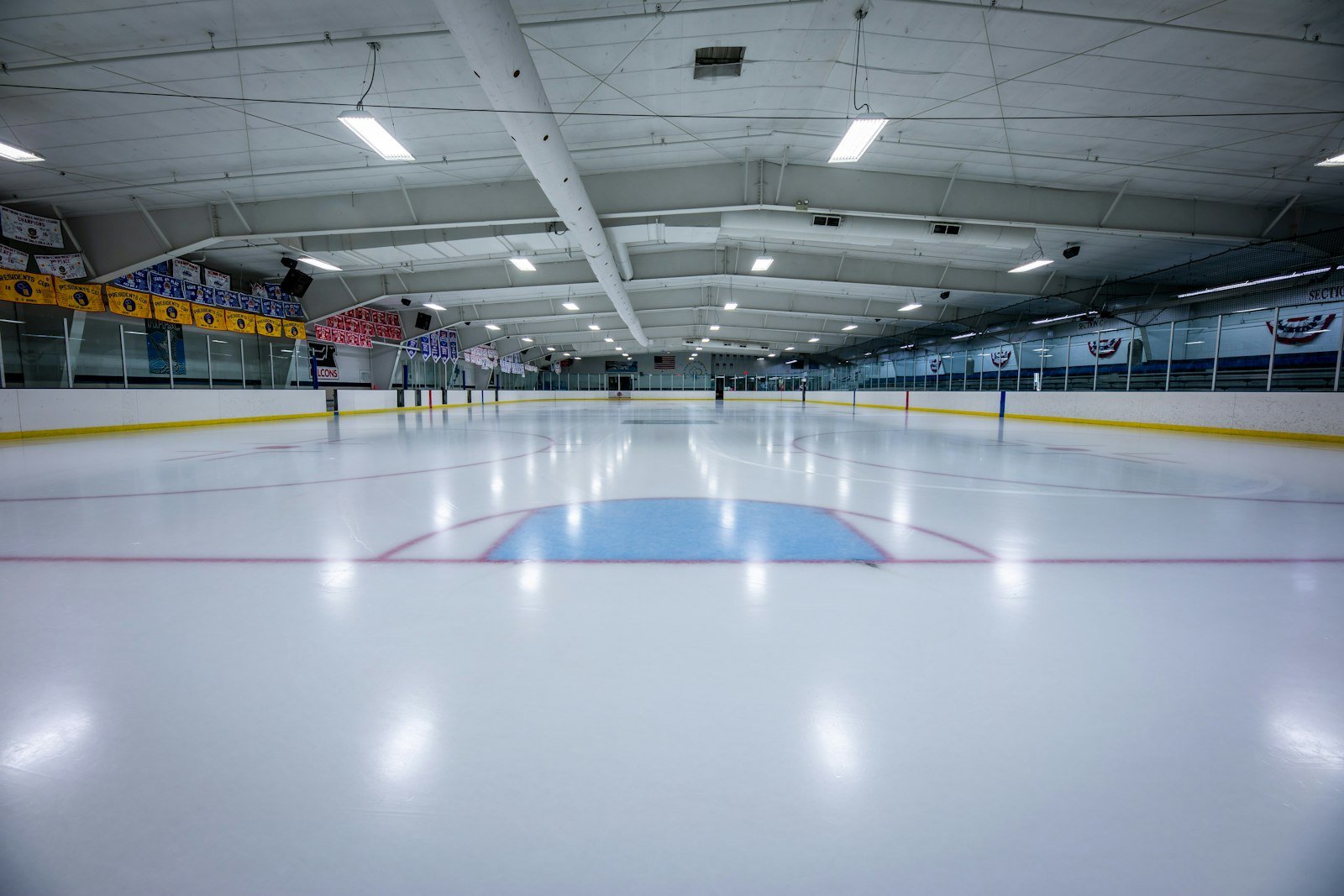
The international hockey federation and Hockey Canada both publish a rule for how big a rink should be. Put the two documents side by side and none of the four Canadian measurements falls inside the international range. The gaps are small, between 3 centimetres and 96 centimetres, and they come from two documents that are doing different jobs.
Hockey Canada recommends a rink 60.96 metres long. The international rulebook says 60. That 96 centimetres is the largest of four small mismatches between the IIHF Official Rulebook 2026/27 and the Hockey Canada Playing Rules 2026-2028. Both documents describe the same sheet of ice.
What each rulebook says about rink size
The IIHF text sits in Rule 1.2. It says the official rink “shall be 60m long and 26m to 30m wide,” with corners rounded to a radius of 7.0 m to 8.50 m. It adds that any deviation for an IIHF competition needs IIHF approval.
Hockey Canada’s Rule 1.2 (a) is built differently. It says the dimensions of a new rink “are recommended to be” a maximum of 60.96 m long and 30.48 m wide, or a minimum of 60.96 m long and 25.91 m wide. The corner radius is a single figure, 8.53 m. The book prints each figure in feet as well: 200, 100, 85 and 28.
Read the verbs. One document says “shall.” The other says “recommended,” and it says it about a new rink. That difference matters for everything below, and we come back to it.
The four numbers, side by side
| Measure | IIHF 2026/27 | Hockey Canada 2026-28 | Canadian figure compared with the IIHF range |
|---|---|---|---|
| Length | 60.00 m | 60.96 m (200 ft) | 0.96 m longer (+1.6%) |
| Narrowest width | 26.00 m | 25.91 m (85 ft) | 0.09 m below the IIHF minimum |
| Widest width | 30.00 m | 30.48 m (100 ft) | 0.48 m above the IIHF maximum |
| Corner radius | 7.00 m to 8.50 m | 8.53 m (28 ft) | 0.03 m above the IIHF maximum |
The column on the right is our arithmetic. Neither organisation publishes it. Length is a fixed figure in both books, so the Canadian rink is simply a different fixed length. The other three land outside the international range, one just below it and two just above.
The Canadian width range is 4.57 m (30.48 minus 25.91). The international range is 4.00 m. Canada’s allowance for variation between two legal rinks is 14.3% wider.
How much ice is that?
Multiply length by width and the picture gets easier to hold. This is a rectangle only: it ignores the rounded corners, so every figure here overstates the real surface by a little.
- Widest Canadian rink: 1,858.06 square metres.
- Narrowest Canadian rink: 1,579.47 square metres.
- Widest international rink: 1,800.00 square metres.
- Narrowest international rink: 1,560.00 square metres.
Two rinks that both satisfy Hockey Canada’s recommendation can differ by 278.59 square metres, or 17.6%. The widest rink in the Canadian recommendation has 19.1% more ice than the narrowest rink the IIHF allows. The international range spans 240 square metres, so the Canadian range is about 16% larger than that.
Nothing in either book calls this a problem. It is a measurement, and we are reporting it as one.
Why a gap is not a breach
The easy misreading is that Canadian rinks break the international rule. They do not, and the two texts explain why.
The IIHF rule governs IIHF competition, and it has its own exit: deviations with IIHF approval. Hockey Canada’s rule is a recommendation for building a new rink. The same rulebook, in Rule 1.3 (b), writes a procedure for blue lines on rinks shorter than 56.39 m (185 ft). So the 200-foot figure is a target for construction, not a floor on what can host a game.
Boards follow the same pattern. Hockey Canada gives a range of 1.02 m to 1.22 m, which is 20 centimetres of allowance. The IIHF names an “ideal” height of 1.07 m, and that figure falls inside the Canadian range. On boards, the two books agree.
What the documents do not say
Neither rulebook explains why its numbers are what they are. The Canadian figures are round numbers in feet, and the international ones are round numbers in metres. That is visible on the page. Whether it is the reason for the gaps is not documented in either book, so we do not claim it.
We also did not compare these figures with any professional league’s rulebook. We did not open those documents, and a figure repeated from memory is not a source.
What the gap means on the ice
A rink built to the Canadian length is 96 centimetres longer than one built to the international length, which is about three feet along the long axis. At the extremes of width, the area difference runs to a few hundred square metres of ice.
We have reported the same pattern in other rulebooks that read as exact: the weight band for a curling stone, the sole thickness table in athletics, the tolerances on a FIFA ball and the carding rate for Canadian athletes. In each, a rule that sounds like a single number turns out to be a range.
Frequently asked questions
How big is an official international hockey rink?
The IIHF Official Rulebook 2026/27 says 60 m long and 26 m to 30 m wide, with a corner radius of 7.0 m to 8.50 m. Deviations in IIHF competitions need IIHF approval.
How big is a hockey rink under Hockey Canada rules?
Hockey Canada’s Playing Rules 2026-2028 recommend a new rink be 60.96 m (200 ft) long and between 25.91 m (85 ft) and 30.48 m (100 ft) wide, with a corner radius of 8.53 m (28 ft).
Is a 200 by 85 foot rink illegal in international play?
The documents do not say so. The Hockey Canada figure is a recommendation for a new rink, and the IIHF rule applies to IIHF competition and allows approved deviations. Whether a given event accepts a given rink is a question for that event’s organiser.
How high are the boards?
Hockey Canada sets boards between 1.02 m and 1.22 m above the ice. The IIHF names an ideal height of 1.07 m, which falls inside the Canadian range.
Sources and method
From the sources. Rule 1.2 and Rule 1.3 of the IIHF Official Rulebook 2026/27, Version 1.0, June 2026, which the IIHF rules page lists as the current edition. Rule 1.2 (a), Rule 1.2 (b) and Rule 1.3 (b) of the Hockey Canada Playing Rules, 16th edition (2026), which the Hockey Canada downloads page lists as “2026-2028, updated July 2026.” We downloaded both PDFs and read the rules in the text.
Edition check. The older file name on the Hockey Canada site still serves the 15th edition (2024). Rule 1.2 (a) reads identically in both editions, so no number in this article depends on which one you open. The online rulebook at rulebook.hockeycanada.ca states it is current to June 2023, so we did not use it.
Raw POV analysis, not published by either organisation. Every figure in the right-hand column of the table, the width ranges of 4.57 m and 4.00 m and the 14.3% difference, and all area figures (length times width, corners ignored, so they overstate real ice by a small amount). Metres are as printed; feet are as printed by Hockey Canada.
Limits. The IIHF text is a requirement for its competitions. The Hockey Canada text is a recommendation for new rinks. We compared the numbers, not their legal force, and we make no claim about any individual arena.