The rulebook that governs curling in Canada changed on 1 September 2026, and two of its numbers moved. A stone may now be half a pound lighter than the old Canadian floor allowed, and the narrowest legal sheet got four inches wider. Both figures come from documents anyone can download, and neither body announced the arithmetic.
Two curling stones can sit side by side in the same house, both perfectly legal, and differ by six pounds. The current rule puts the ceiling at 19.96 kg (44 lbs) including handle and bolt, and the floor at 17.24 kg (38 lbs). That gap is 2.72 kg, or 13.6 percent of the heaviest stone the rule permits. Nothing about it is an oversight. Granite is quarried, cut and finished, not injection moulded, and the rule is written to fit the material.
What changed this month is which rulebook says so in Canada. Until 31 August 2026, club play here ran on Curling Canada’s own general play book, published in September 2022 with an expiry printed on its first page. That book set the floor at 38.5 lbs (17.46 kg). The book Curling Canada posted on 1 September 2026 sets it at 38 lbs, because in the sections that define the stone and the sheet it is the World Curling text, character for character.
We checked that claim rather than assuming it. Both PDFs were downloaded and the text extracted, and rules R1 and R2 in the Curling Canada edition are byte for byte identical to R1 and R2 in the World Curling edition of the same date. The match is exact. The Canadian version adds one sentence the world version does not carry, and it matters: member associations, clubs and leagues may modify any of these rules to suit their needs.
The three specifications that moved in the Canadian book
Comparing the expired Canadian book with the one now in force turns up three differences in the parts that describe equipment and playing surface. The table below sets them against each other. Every figure is quoted from one of the two documents.
| Specification | Canadian book, Sept 2022 to Aug 2026 | Canadian book, from 1 Sept 2026 |
|---|---|---|
| Minimum stone weight | 38.5 lbs (17.46 kg) | 38 lbs (17.24 kg) |
| Maximum stone weight | 44 lbs (19.96 kg) | 44 lbs (19.96 kg) |
| Minimum sheet width | 14 ft 2 in (4.318 m) | 14 ft 6 in (4.420 m) |
| Maximum sheet width | 15 ft 7 in (4.750 m) | 15 ft 7 in (4.750 m) |
| Sheet length | Recommended 146 ft to 150 ft | Minimum 150 ft, reducible to 146 ft where a facility cannot fit it |
| Stones provided per sheet | Two sets of eight, stated as a requirement | No provisioning clause; each team uses a set of eight |
Read as ranges rather than as single numbers, the two changes pull in opposite directions on the same day. The legal weight band for a stone widened from 5.5 lbs to 6 lbs, which is 9.1 percent more slack than the old Canadian book allowed. The legal width band for a sheet narrowed from 17 inches to 13 inches, which is 23.6 percent less. Those two percentages are ours. Neither body publishes them.
A club that built its ice to the old Canadian minimum width is the interesting case here, and the rulebook answers for it. That modification sentence leaves clubs and leagues free to adapt the rules to their facilities, so a narrow sheet does not become illegal in any practical sense. What changed is the default the book starts from.
Most of a curling sheet is not a place a stone may stop
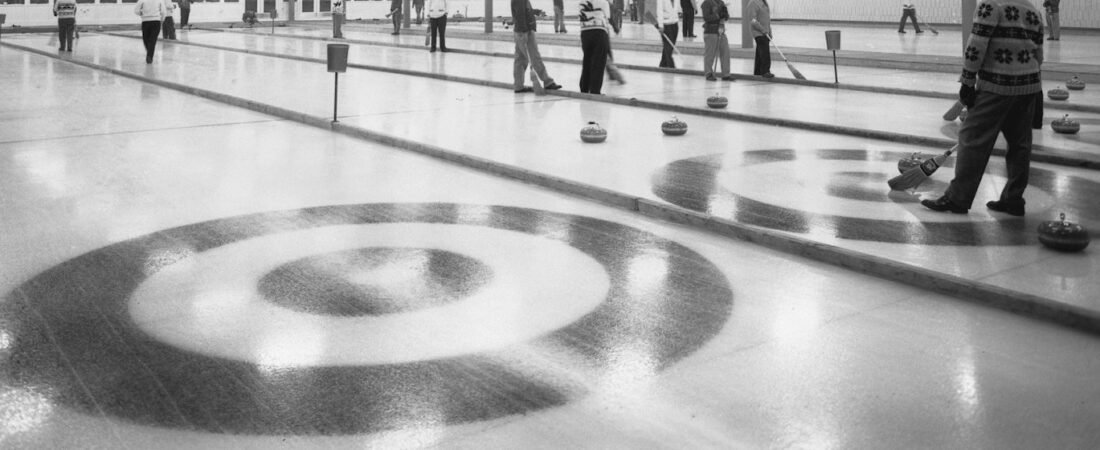
The sheet carries tolerance of its own, and the amounts are bigger than the televised game suggests. Length may fall from 45.720 m (150 ft) to 44.501 m (146 ft) where an existing building will not take the full measure, a permitted difference of exactly four feet. Width may fall from 4.750 m to 4.420 m, a difference of 13 inches. Your club’s ice is very likely not the size of the ice on television.
Then there is the part of the rule that surprised us. Measured along the sheet, the zone where a delivered stone may legally come to rest runs from the inside edge of the far hog line, 6.401 m from the tee, to the outside edge of the back line, 1.829 m past it on the other side. That band is 8.230 m long. On a full length sheet, it is 18.0 percent of the ice. The other 82 percent is runway.
The house is smaller than it looks too. The outer circle has a radius of 1.829 m, which gives an area of 10.51 square metres. A stone with the maximum legal circumference of 914 mm has a base of 0.0665 square metres. Divide one by the other and about 158 stone footprints fit inside the twelve foot circle. Sixteen stones, the full complement for both teams, cover roughly a tenth of it. Those figures are ours, derived from the published dimensions.
How a stone’s slack compares with a football’s
Raw POV has measured this kind of tolerance twice before. World Athletics allows 40 millimetres of sole on the road and 20 on the track, and FIFA’s testing manual sets three tiers of ball, of which the professional mark is exactly twice as tight as the other two on circumference.
Putting curling next to football needs care, and the first attempt at this comparison failed the test. Setting the stone’s weight band against the ball’s circumference band produces a ratio near thirty to one, and the ratio is meaningless, because weight and circumference are different quantities with different denominators. We dropped it. The comparison only works on the same measure. So we used weight in both cases, expressed as the width of the legal band divided by the midpoint of that band.
| Object and standard | Legal weight range | Band as a share of the midpoint |
|---|---|---|
| Curling stone, World Curling and Curling Canada 2026 | 17.24 to 19.96 kg | 14.6% |
| Size 5 football, FIFA QUALITY | 410 to 450 g | 9.3% |
| Size 5 football, FIFA QUALITY PRO | 420 to 445 g | 5.8% |
By that measure the curling stone carries about 2.5 times the relative weight slack of a top grade match ball, and about 1.6 times that of a standard one. The football figures come from the thresholds Raw POV published from FIFA’s manual; the curling figure is calculated here from the two rulebooks.
What the rulebooks do not say
Neither document explains any of it. The rules state the numbers and stop. No passage gives a reason for a six pound band, for the four inch change to the minimum width, or for dropping the clause that used to require two sets of eight stones per sheet. Anyone writing that the band exists because granite is hand finished, this article included, is offering an explanation the documents do not make.
The change also dates one of our own numbers. Our piece on where curling stones are quarried used the 38.5 lb floor and the per sheet provisioning clause from the Canadian book that has since expired. The granite, the quarries and the club counts in that piece stand. The two rule figures in it now describe the previous edition, not the current one.
One more limit is worth stating plainly. We did not establish when the world text first used the word minimum for sheet length. The July 2024 world edition, still hosted on the same site, states length as a flat 45.720 m, and the edition in force states it as a minimum of 45.720 m. Whether that wording arrived in 2025 or in 2026, we cannot say from the two documents we read. We are not guessing.
Frequently asked questions
How much can a curling stone legally weigh?
Between 17.24 kg (38 lbs) and 19.96 kg (44 lbs), including handle and bolt, under rule R2(a) of the edition in force from 1 September 2026. Two legal stones can therefore differ by six pounds.
Did Canada’s curling rules change in 2026?
Yes. Curling Canada’s previous general play book was published in September 2022 and expired in August 2026. The book posted on 1 September 2026 uses the World Curling text in the sections covering the sheet and the stones, which lowered the minimum stone weight from 38.5 lbs to 38 lbs and raised the minimum sheet width from 14 ft 2 in to 14 ft 6 in.
How long and how wide is a curling sheet?
A minimum of 45.720 m (150 ft) long and a maximum of 4.750 m (15 ft 7 in) wide. Where an existing building cannot accommodate that, the length may be reduced to 44.501 m (146 ft) and the width to 4.420 m (14 ft 6 in).
How big is the house in curling?
Four concentric circles, the outermost with a radius of 1.829 m (6 ft), then 1.219 m, then 610 mm, with an innermost circle of at least 152 mm. The outer circle covers about 10.5 square metres, enough for roughly 158 stone bases, while the sixteen stones both teams bring cover about a tenth of it.
Sources and method
From the sources. All rule text and every published dimension comes from three documents, each downloaded and read in full for this article: World Curling, The Rules of Curling and Rules of Competition, 1 September 2026; Curling Canada, The Rules of Curling, 1 September 2026, linked from the association’s rules page; and Curling Canada, Rules of Curling for General Play, September 2022 to August 2026. The wording of the older world edition was checked against the July 2024 rulebook. The football thresholds are the ones Raw POV published from FIFA’s Testing Manual for the FIFA Quality Programme for Footballs, version 1.1, 1 October 2022, section 4.1.
Raw POV analysis. The following are our calculations and appear in none of the documents: the six pound band expressed as 13.6 percent of the maximum stone weight and 14.6 percent of the midpoint; the widening of the Canadian weight band from 5.5 lbs to 6 lbs, or 9.1 percent; the narrowing of the Canadian width band from 17 inches to 13 inches, or 23.6 percent; the 8.230 m zone in which a delivered stone may legally rest and its 18.0 percent share of a full length sheet; the 10.51 square metre area of the twelve foot circle, the 0.0665 square metre stone base derived from the 914 mm circumference limit, and the resulting count of about 158 footprints; and the comparison of weight bands with the two FIFA marks. The identity of rules R1 and R2 across the two 2026 rulebooks was established by extracting both texts and comparing them character by character, not by reading a summary. The same approach produced our count of visitors across 119 Parks Canada places, where the published file, not a press summary, carried the finding.
What we could not verify. The documents give no reason for any of the values or for the changes between editions, and we have not attributed motives to either organisation. We did not determine the edition in which the world text first described sheet length as a minimum. We also did not survey how many Canadian clubs have ice at the old minimum width, which would require facility by facility measurement that no public dataset provides.