

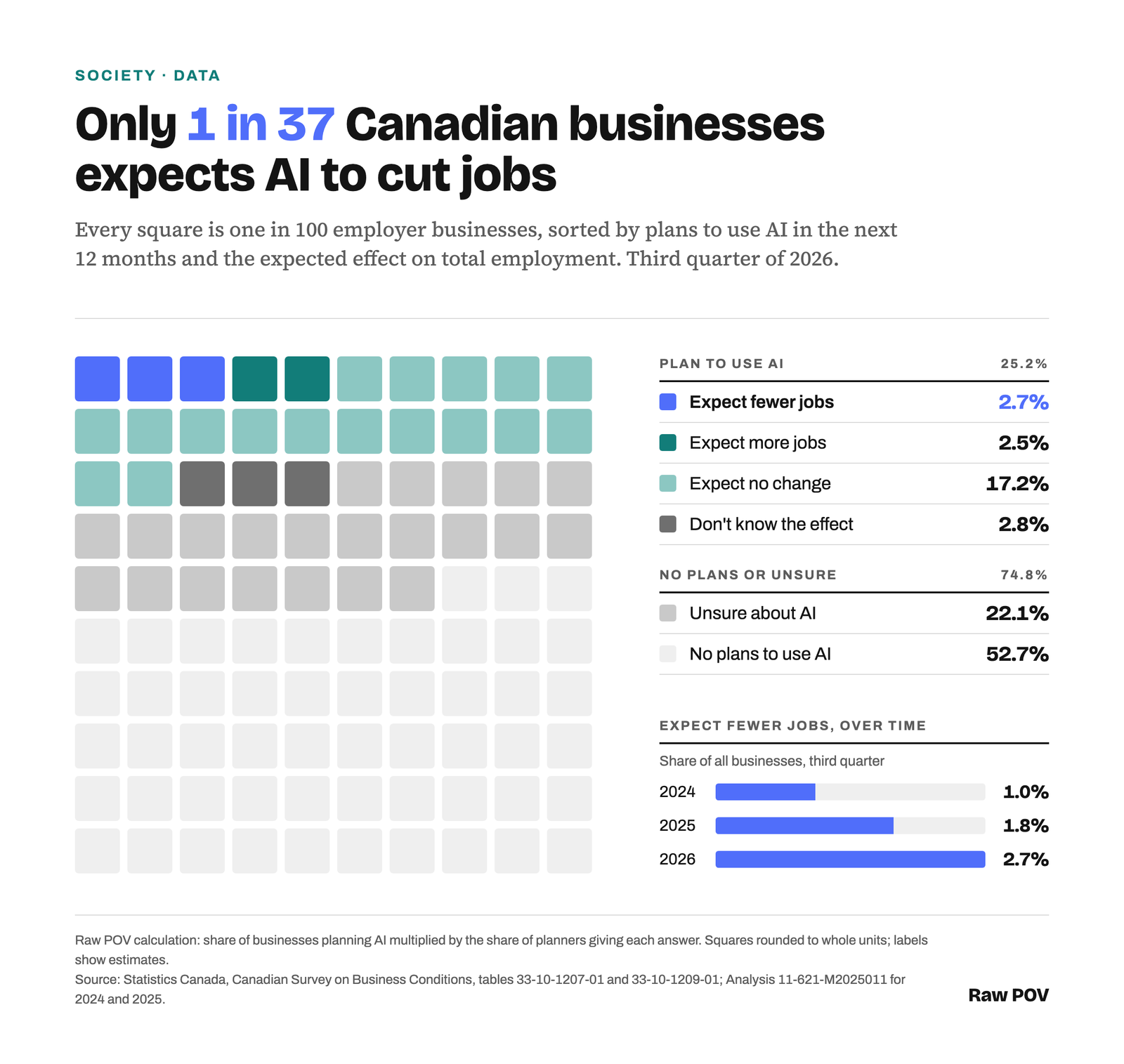
Statistics Canada asked businesses that plan to use AI what they expect it to do to their headcount. Carried onto the base of all businesses, the answer covers a small slice of the economy: about 2.7 in every 100 Canadian employer businesses, roughly 1 in 37, plan to use AI and expect it to shrink their workforce over the next year. That share has nearly tripled in two years.
I went looking for this number because the published one is easy to misread. In its latest survey of business conditions, Statistics Canada reports that 10.8% of businesses planning AI expect it to decrease their total employment. Read without that qualifier, the figure could pass for one employer in ten preparing cuts. But the question was only put to businesses that had already said yes to planning AI, and those are 25.2% of all employer businesses. Multiply the two and the share of all businesses that both plan AI and expect fewer jobs falls to 2.7%.
The source is the third quarter 2026 edition of the Canadian Survey on Business Conditions, table 33-10-1209-01, collected from July 2 to August 6, 2026. The headline adoption figures appeared in The Daily on August 31 and in a Statistics Canada analysis published October 1. Neither text reports the employment question. The answers sit in the data table.
What businesses planning AI expect for their headcount
Among Canadian businesses that plan to use AI to produce goods or deliver services in the next 12 months, the table shows four answers, all rated A, the agency’s highest quality grade:
- 68.1% expect total employment to stay the same
- 10.8% expect it to decrease
- 9.8% expect it to increase
- 11.3% do not know
The two ends are close. A one point gap between two sample estimates is not enough to say that more businesses expect to cut than to hire, so the fair reading is that the two expectations are roughly level. The dominant answer, by a wide margin, is no change.
The question also has a time limit. Respondents were asked about the next 12 months, which, depending on when they answered, runs from July 2026 to August 2027. These are expectations, not measured job changes.
The same answers on the base of all businesses
The survey splits all employer businesses three ways on AI: 25.2% plan to use it in the next year, 52.7% do not, and 22.1% are unsure. Raw POV has already looked at how that undecided middle grew. Carrying the employment answers onto the same base gives a picture of the whole economy rather than of the planners alone.
Of every 100 Canadian employer businesses, then, roughly 53 have no AI plans, 22 are undecided, 17 plan AI and expect no change in headcount, about 3 plan AI and expect fewer jobs, about 2.5 plan AI and expect more, and about 3 plan AI without knowing what it will do to staffing. Statistics Canada does not publish this breakdown. It is our multiplication of two published tables, and it carries the sampling error of both.
Put another way, 97 of every 100 employer businesses did not report both a plan to use AI and an expectation that it will reduce their headcount. That does not mean none of them will cut jobs: the survey asked only about AI, and only of businesses planning to use it.
Two years of the same question
The survey has asked the employment question in the third quarter of every year since 2024. Statistics Canada reported the earlier answers in its 2025 analysis of expected AI use. Among planners, the share expecting a decrease went from 9.4% in 2024 to 12.2% in 2025 and 10.8% in 2026. The share expecting no change barely moved: 69.2%, 69.9%, 68.1%.
What changed is the size of the group being asked. Planned use rose from 10.6% of businesses in 2024 to 14.5% in 2025 and 25.2% in 2026. Because the proportions inside the group held roughly steady while the group more than doubled, the share of all businesses expecting AI to cut jobs climbed from about 1.0% to 1.8% to 2.7%. That is 2.7 times the 2024 level. The share expecting AI to add jobs grew too, from about 1.2% to 2.5%, or 2.1 times.
So both statements are true at once. Inside the planning group, the mood on jobs is stable. Across the economy, more businesses hold every one of these expectations, simply because more of them now plan to use AI at all.
How the picture changes with business size
The same table breaks the answers down by number of employees, and the planning table does the same for adoption. Here the two are combined on the base of all businesses in each size band. Several of the underlying cells carry B or C quality ratings, so treat the size rows as indicative rather than precise.
| Employees | Plan to use AI | Plan AI, expect fewer jobs | Plan AI, expect more jobs | Plan AI, expect no change | Plan AI, do not know |
|---|---|---|---|---|---|
| 1 to 4 | 25.6% | 3.0% | 2.7% | 16.9% | 3.0% |
| 5 to 19 | 21.0% | 1.6% | 2.0% | 15.9% | 1.5% |
| 20 to 99 | 32.8% | 4.4% | 2.9% | 20.8% | 4.7% |
| 100 or more | 37.5% | 2.6% | 1.6% | 23.9% | 9.3% |
| All sizes | 25.2% | 2.7% | 2.5% | 17.2% | 2.8% |
Share of all employer businesses in each size band. Raw POV calculation from Statistics Canada tables 33-10-1207-01 and 33-10-1209-01, third quarter of 2026.
Two things stand out. In no size band does the share of businesses expecting AI-related cuts reach 5%. And the largest employers are the least certain: among businesses with 100 or more staff that plan AI, 24.9% said they do not know what it will do to employment, more than twice the overall rate. On the base of all large businesses, that uncertain group is larger than the groups expecting cuts and expecting hires put together.
Raw POV has measured earlier that large Canadian firms are about four times as likely to train staff on AI as the smallest ones. The size pattern here is a different question, about expectations rather than practice, and the data do not say why larger firms are less sure.
What owners who already use AI reported
Expectations can be checked, at least partly, against experience. In the second quarter of 2025, Statistics Canada asked businesses that had used AI in the previous 12 months what had happened to their employment. According to the agency’s 2025 analysis, 89.4% reported no change, 6.3% a decrease and 4.3% an increase. Those were different businesses, answering a backward looking question a year earlier, so the figures cannot be lined up with this year’s expectations one to one. They do point the same way: among businesses already working with AI, the most common outcome reported for headcount was none.
What the data cannot show
The table counts businesses, not workers. A single large employer expecting cuts weighs the same in these percentages as a two person shop, so 2.7% of businesses is not 2.7% of jobs, and nothing here estimates how many positions could be affected. The survey covers employer businesses only, so sole proprietors with no staff are outside it. Expectations for 12 months say nothing about the longer run.
Wording matters too. How a survey frames a category shapes the number it produces, something Raw POV ran into when looking at how the census counts Latin Americans. Here, “total employment” refers to employees who receive a T4 slip, which leaves out owners and contract workers, as the table’s own notes state.
Frequently asked questions
What share of Canadian businesses expect AI to reduce jobs?
About 2.7% of Canadian employer businesses both plan to use AI in the next 12 months and expect it to decrease their total employment, based on Statistics Canada survey data from the third quarter of 2026. Among only the businesses planning AI, the figure is 10.8%.
Do most Canadian businesses using AI expect to cut staff?
No. Among businesses planning to use AI, 68.1% expect total employment to stay the same, 10.8% expect a decrease, 9.8% expect an increase and 11.3% do not know, according to Statistics Canada table 33-10-1209-01.
How many Canadian businesses plan to use AI?
In the third quarter of 2026, 25.2% of Canadian employer businesses planned to use AI to produce goods or deliver services over the next 12 months, up from 14.5% in 2025 and 10.6% in 2024. Another 52.7% had no plans and 22.1% were unsure.
Sources and method
From the source. All survey figures come from Statistics Canada’s Canadian Survey on Business Conditions. Third quarter 2026: table 33-10-1209-01 (expected impact of AI on total employment) and table 33-10-1207-01 (planned AI use), downloaded as CSV from Statistics Canada on October 15, 2026, Canada rows. The table’s note 9 states that the employment question was asked only of businesses that answered yes to planning AI. The 2024 and 2025 employment figures and the 2025 figures on businesses already using AI are taken from Statistics Canada’s Analysis on expected use of artificial intelligence by businesses in Canada, third quarter of 2025. The 2026 sample was 21,161 businesses, with 9,601 responding, according to the October 1, 2026 analysis.
Raw POV analysis. Every figure expressed as a share of all businesses (2.7%, 17.2%, 2.5%, the size table, the 2024 and 2025 equivalents, and the 2.7 times and 2.1 times growth) is our own calculation: the published share of businesses planning AI multiplied by the published share of planners giving each employment answer. Statistics Canada does not publish these products. Because each input is a sample estimate, the products are approximate, and they are less reliable where an input carries a B or C quality rating, which applies to several cells in the size breakdown. For another reading of Statistics Canada survey data, on how Canadian households spend, see our analysis of household spending on communication. We did not find another outlet reporting the employment table on the base of all businesses, but our search was not exhaustive.