In recent years, a growing number of Latino families across North America have begun questioning a story many inherited without ever examining it: that their roots trace cleanly back to Spain, with little room for Indigenous or African ancestry. The trigger has been the same for millions of people regardless of background, inexpensive at-home DNA kits and newly searchable historical archives, but for Latino families, the results are often reshaping one specific inherited myth: that of “pure” Spanish lineage.
A widely discussed NBC News investigation, “They’re uncovering their ancestry, and questioning their families’ racial narratives,” profiled several U.S. families going through this exact reckoning. The pattern isn’t confined to the United States, though. Genealogists and historians working across Latin America, the Caribbean, and diaspora communities further north describe the same phenomenon: family trees that quietly wrote Indigenous and African ancestors out of the story.
Where the myth came from
The idea of a “pure” Spanish or European lineage in Latin America wasn’t an accident of memory, it was policy. During the colonial era, many Latin American societies operated under casta systems that ranked people by perceived racial purity, with proximity to “Spanish blood” determining legal privilege, property rights, and social standing. Historians estimate that well over a million enslaved Africans were forcibly brought to Spanish American colonies between the 16th and 19th centuries. Yet official records and family Bibles frequently omitted or obscured that ancestry, a habit many families continued for generations after independence.
What the archives, and the DNA, are showing
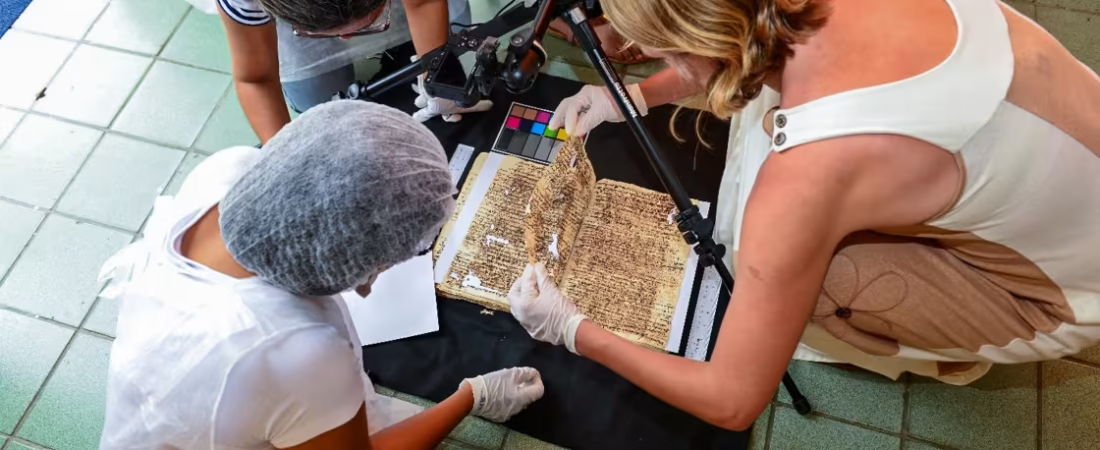
Two things made the myth harder to sustain. First, projects like the Slave Societies Digital Archive have spent over a decade digitizing sacramental and notarial records from Latin America and the Caribbean, baptism, marriage, and death records that name enslaved and free Black and Indigenous ancestors explicitly, often in registers families never had access to before. Second, consumer DNA testing turned an abstract historical possibility into a specific, personal number: a percentage of Sub-Saharan African or Indigenous American ancestry sitting next to a person’s name.
For some families, that number confirms oral history that survived in fragments, a grandmother’s photo, a nickname, a rumor about a great-great-grandfather. For others, it contradicts a family identity that had calcified around being “white” or “mestizo,” sometimes after generations of active effort to distance the family from Blackness or Indigeneity.
A Canadian dimension to the same story
The reckoning isn’t confined to the U.S. Toronto is home to one of Canada’s fastest-growing Latin American communities, and it shows up in local cultural life: Raw POV’s own coverage of groups like Suraras do Tapajós, who bring Afro-Indigenous Carimbó from the Amazon to venues like Drom Taberna, and the city’s growing Forró and Afro-Brazilian dance scenes, reflects the same underlying shift, diaspora communities publicly reclaiming Indigenous and African threads of Latin American identity that were historically minimized at home. For Toronto-based readers curious about their own family history, local Latin American cultural associations and university Latin American Studies departments are a natural starting point.
Starting your own search
For readers who want to look into their own family history rather than take the old narrative at face value, genealogists generally point to the same starting places:
- Consumer DNA tests (AncestryDNA, 23andMe, MyHeritage) estimate broad regional ancestry, useful as a prompt for further research, though accuracy varies by region and reference database.
- The Slave Societies Digital Archive (slavesocieties.org) hosts free, searchable colonial-era church records from across Latin America and the Caribbean.
- FamilySearch and local Family History Centers offer free access to digitized civil and church records for most Latin American countries.
- Local Latin American cultural associations and university Latin American Studies departments increasingly connect family-history research to community identity projects.
Why it matters beyond one family tree
None of this erases anyone’s culture, if anything, it expands it. A Latino identity built on acknowledging Indigenous and African ancestry isn’t a smaller or more divided one; it more accurately reflects the demographic reality of a region shaped by conquest, slavery, and both forced and voluntary migration in equal measure. As archives keep digitizing and DNA databases keep growing, family historians expect this quiet reckoning to keep gaining momentum, not just in the U.S., but everywhere Latin American diaspora communities are asking harder questions about where they actually come from.
Source: Rueda, Edward. “They’re uncovering their ancestry, and questioning their families’ racial narratives.” NBC News.