Lacrosse has been legally recognised as Canada’s national summer sport since 1994, but it existed for centuries before any government put it in writing. It began as a ceremonial game among Indigenous nations, was renamed and rewritten by a 19th century dentist, and then spent more than a century locking out the people who invented it. Here is the documented history, with the sources attached.
Every summer, thousands of Canadian kids lace up for box lacrosse in hockey rinks turned over for the warm months, most of them unaware that the sport has a legal status few other games can claim, or that its origins have nothing to do with the rink at all.
Lacrosse is one of two sports named directly in Canadian law. The National Sports of Canada Act, passed by Parliament in 1994, states plainly: “The game commonly known as ice hockey is hereby recognized and declared to be the national winter sport of Canada and the game commonly known as lacrosse is hereby recognized and declared to be the national summer sport of Canada.” Canada is widely described, including by sports historians and Canadian government-adjacent sources, as the only country to have legislated two national sports this way. It is a striking sentence for a game that, for a hundred years before it, was systematically closed to the nations who created it.
From the Creator’s Game to a French missionary’s notebook
Long before any European saw it, versions of the game were played across Indigenous nations in northeastern and southeastern North America, under different names in different languages: tewaarathon among the Mohawk, baggataway among the Algonquin, dehontsigwaehs among the Onondaga, baaga’adowe among the Ojibwe. Many Haudenosaunee (Iroquois) communities know it as the Creator’s Game, a gift used to honour elders, heal communities, settle disputes between nations and mark ceremony, sometimes played by hundreds of participants across open country rather than a marked field.
The first written European record comes from the 1630s, when French Jesuit missionaries in the St. Lawrence Valley described the Huron-Wendat playing a stick-and-ball game. Jean de Brébeuf documented it in 1637 and the sport picked up the French name la crosse, after the hooked stick, which is where the modern name comes from.
How the sport’s own governing body wrote Indigenous players out of it
The modern, codified version of lacrosse comes from one man. William George Beers, a Montreal dentist, founded the Montreal Lacrosse Club in 1856 and, over the following decade, rewrote the game: shorter matches, fixed player counts, standardised equipment and a rubber ball in place of a wooden or deerskin one. The first match under his rules was played at Upper Canada College in 1867, the same year the National Lacrosse Association, the first national sport governing body in North America, was founded on the back of his club.
That codification came bundled with exclusion. Beers’ own 1869 rulebook included a clause stating that “no Indian must play in a match for a white club, unless previously agreed upon.” By 1880 the National Lacrosse Association had reorganised as an amateur-only body and barred Indigenous teams from championship competition outright, on the official grounds that they were professionals. Historians who have examined the ruling generally treat that justification with scepticism, since it arrived not long after Indigenous teams had repeatedly outplayed the clubs that were now writing the rules.
The practical result: the nations that invented lacrosse were shut out of organised, national-level competition in the sport built from their own game for more than a century.
Two versions of the same game: box lacrosse and field lacrosse
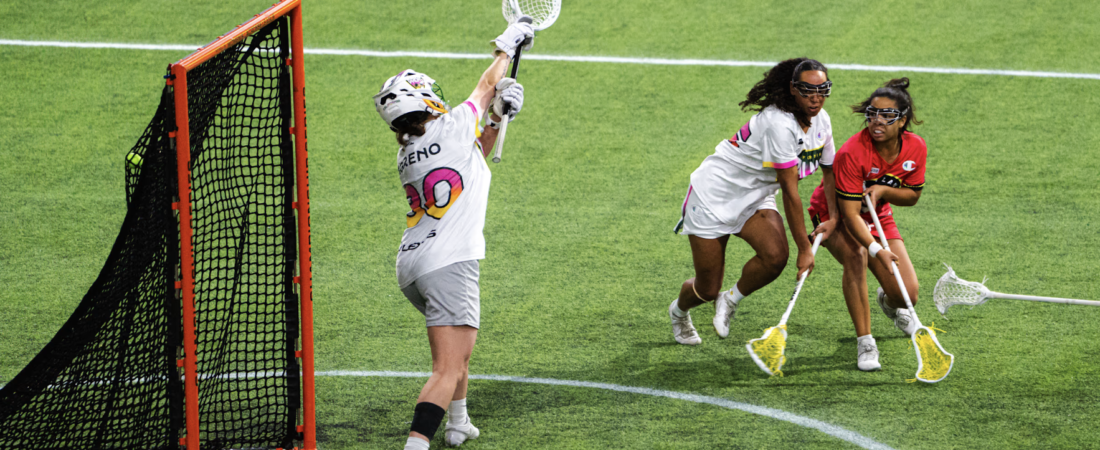
Canadians who play lacrosse today are, more often than not, playing a different version of it than the one played at the Olympics in 1904 and 1908. Box lacrosse, invented in Canada in the 1930s as an indoor variant that could use empty hockey rinks and survive the winter off-season, became the dominant form of the sport across the country. The two versions now coexist with meaningfully different rules.
| Feature | Box lacrosse | Field lacrosse |
|---|---|---|
| Where it is played | Indoors, typically a hockey rink floor boarded off | Outdoors, on a field roughly 110 by 60 yards |
| Players per side | 6, including the goalie | 10, including the goalie |
| Shot clock | Yes, typically 30 seconds | Traditionally none; varies by league and level today |
| Out of bounds | Rare, the ball bounces off the boards and play continues | Common, given the open field |
| Pace and contact | Fast, tight, closer to hockey or basketball in feel | More spread out, more running between plays |
Box lacrosse is why the sport has such deep roots in Canadian arenas that already exist for hockey. It did not need new infrastructure. It needed an empty rink in July, which every town with a hockey team already had.
The 110 years it took to come back
The return of Indigenous nations to organised international lacrosse did not happen quickly, and it did not happen automatically once the sport gained legal status in Canada.
In 1983, the Grand Council of the Haudenosaunee sanctioned a team, the Iroquois Nationals, ahead of exhibition matches at the NCAA championship in Baltimore. The International Lacrosse Federation denied the team membership for the 1986 World Championship, then admitted it as a full member nation in 1988. The Iroquois Nationals played their first official World Championship in 1990, in Perth, Australia, finishing fifth of five teams.
That 1990 tournament was, by Raw POV’s own count from the documented dates above, the first international competition an Indigenous lacrosse team had played since the National Lacrosse Association’s 1880 exclusion, a gap of 110 years between being barred from the sport’s championship structure and returning to it at the international level. The team went on to win bronze medals at the 2014, 2018 and 2023 World Championships and, in 2022, renamed itself the Haudenosaunee Nationals. In 2025, the governments of Canada and the United States issued a joint statement backing the team’s bid to compete under its own flag at the 2028 Los Angeles Olympics, where lacrosse is set to return to the Games for the first time since 1908.
A timeline of dates that are easy to find and rarely put next to each other
| Year | Event | Years ago (from 2026) |
|---|---|---|
| 1637 | Jean de Brébeuf documents the Huron-Wendat playing the game | 389 |
| 1856 | William George Beers founds the Montreal Lacrosse Club | 170 |
| 1867 | National Lacrosse Association founded on codified rules | 159 |
| 1880 | National Lacrosse Association bars Indigenous teams from championship play | 146 |
| 1930s | Box lacrosse invented in Canada as an indoor variant | about 90 |
| 1983 | Haudenosaunee Grand Council sanctions the Iroquois Nationals | 43 |
| 1988 | International Lacrosse Federation admits the team as a full member | 38 |
| 1990 | First World Championship played, first Indigenous return to international play since 1880 | 36 |
| 1994 | National Sports of Canada Act names lacrosse the national summer sport | 32 |
| 2022 | Team renames itself the Haudenosaunee Nationals | 4 |
| 2025 | Canada and the US back the team playing under its own flag at the 2028 Olympics | 1 |
Lacrosse Canada, the sport’s current national governing body, traces its own lineage back to that 1867 association and today works with 11 provincial and territorial member associations to run the game from minor box leagues up to the national team. It is, by its own account, a much larger and more inclusive structure than the one it descended from, though it does not publicly report a current national participation figure, so Raw POV is not printing one here.
Frequently asked questions
Is lacrosse really Canada’s national sport?
It is one of two. The National Sports of Canada Act, passed by Parliament in 1994, names ice hockey as the national winter sport and lacrosse as the national summer sport. Canada is commonly cited as the only country to have legislated two national sports this way.
Who invented lacrosse?
Indigenous nations in northeastern and southeastern North America played versions of the game long before European contact, under names including tewaarathon, baggataway and dehontsigwaehs. Many Haudenosaunee communities call it the Creator’s Game. French missionaries first documented it among the Huron-Wendat in the 1630s.
What is the difference between box lacrosse and field lacrosse?
Box lacrosse is played indoors, usually in a boarded-off hockey rink, with six players a side and a shot clock. Field lacrosse is played outdoors on a larger field with ten players a side. Box lacrosse, invented in Canada in the 1930s, became the country’s dominant form of the game.
Were Indigenous players ever banned from lacrosse?
Yes. The National Lacrosse Association, the sport’s own governing body, barred Indigenous teams from championship competition in 1880. An Indigenous team did not return to international competition until the Iroquois Nationals played the 1990 World Championship, a gap of 110 years.
Who are the Haudenosaunee Nationals?
Formerly known as the Iroquois Nationals, the team was sanctioned by the Haudenosaunee Grand Council in 1983 and admitted to the sport’s international federation in 1988. It has won three World Championship bronze medals and, in 2025, received joint backing from Canada and the United States to compete under its own flag at the 2028 Olympics.
Sources and method
The legal text of Canada’s national sports designation comes from the National Sports of Canada Act on the Justice Laws Website, quoted directly. Historical dates on Indigenous origins, the Montreal Lacrosse Club, the National Lacrosse Association and the 1880 exclusion draw on Wikipedia’s sourced history of lacrosse and Lacrosse Canada’s own history page, cross-checked against both. Details on the Haudenosaunee Nationals, including its founding, federation membership, competition results and 2025 Olympic recognition, come from the team’s documented record. Box and field lacrosse rule differences are drawn from lacrosse governance and instructional sources and reflect general, stable rules rather than a single league’s current rulebook. The “years ago” column in the timeline table and the 110-year gap between 1880 and 1990 are Raw POV’s own calculations from the dates above, not figures published by any source. Raw POV was not able to independently verify current national lacrosse participation numbers in Canada and has therefore left that figure out rather than repeat an unconfirmed one.
Read more from Raw POV: what is futsal, the small-sided game now played in Canada, the Indigenous warriors bringing Amazonian carimbo to Toronto, and the 2026 World Cup legacy that is not a stadium. Or browse all Raw POV Sports coverage.