
I have lived in Toronto long enough to have a short list of places I return to without planning it. Writing them down, I noticed something I had not thought about: three of the four cost nothing to walk into. The fourth costs fifteen dollars and keeps its doors open for six and a half hours, which works out to about $2.31 an hour.
This is not a ranking, and it is not a guide to the best anything. It is four places one person actually goes, with the practical details checked so you can decide whether they are for you. Toronto is an expensive city to spend an afternoon in. What these four have in common, I realised only after listing them, is that none of them hurry you.
Value Village, for looking rather than buying
I go to browse. Thrift shopping is a slow, curious activity, and most of the time I leave with nothing. The shelves are a record of what a neighbourhood owned and let go of, which is a different kind of interesting from a store where everything arrived in the same delivery.
One thing worth knowing, because a lot of shoppers have it backwards: Value Village is a for-profit business, not a charity. Its parent company, Savers Value Village, has traded on the New York Stock Exchange under the ticker SVV since June 2023. The model works the other way round from how it is often assumed. The company buys used goods from nonprofit partners, paying them by weight, which means donating your things generates money for those nonprofits. Shopping in the store does not.
The company reports paying more than $490 million to its nonprofit partners between 2020 and 2024, and diverting some 3.2 billion pounds of goods from landfill. It runs more than 315 locations across the United States, Canada and Australia, roughly 135 of them Value Village stores in Canada. None of that makes browsing better or worse. It just means you know what the transaction is.
Fiesta X, four rooms and four rhythms
This is the one I would send a stranger to. Every Saturday, DanceLifeX at 619 Yonge Street, at Yonge and Bloor, runs a Latin social called Fiesta X across four rooms, each with its own rhythm: salsa, bachata, kizomba, and Brazilian zouk.
The structure is what makes it work for a beginner. Lessons run from 8pm to 10pm in all four rooms, open to all levels, and then the social dancing carries on until 2:30am. You do not need to bring a partner. Admission is $15 at the door and that covers both the lessons and the night.
Do the arithmetic and it is the cheapest long evening on this list. Fifteen dollars across six and a half hours is about $2.31 an hour, and that includes being taught something. I have occasionally seen forró played there too, though I should be clear that forró is not part of the advertised four-room programme, so do not turn up expecting it.
If you have never done any of this, the four-room format solves the usual problem of a social night, which is being stuck with one rhythm you cannot dance yet. Here you can leave a room.
Second Cup, and an honest admission
I go to one specific Second Cup for the hot chocolate with almond milk, which I find creamier than anywhere else I have tried. I want to be straightforward about what that sentence is: a preference, not a measurement. I have not run a comparison, nobody has, and you may well disagree.
What I can tell you factually is what the chain is. Second Cup was founded in 1975 and is Canada’s third largest coffee-focused chain, behind Tim Hortons and Starbucks. In February 2021 it was sold by Aegis Brands to Foodtastic, a Quebec company, for $14 million, at which point it had around 231 locations in Canada, about 200 of them franchises.
The reason it makes this list is not the company. It is that a single drink buys a couple of hours at a table, which in a downtown where most seating now comes with a time limit is the actual product.
Queen’s Park, and the building most people walk past
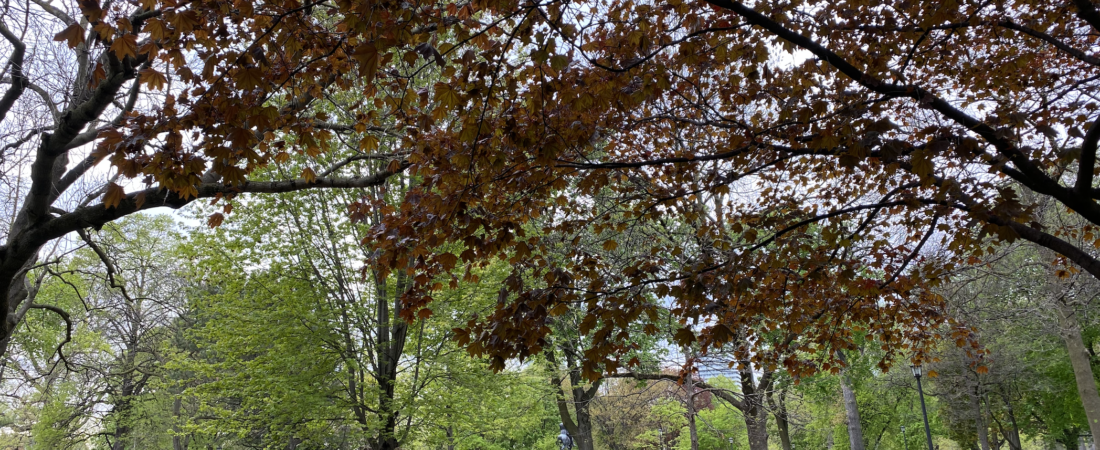
Queen’s Park is an urban park in downtown Toronto, opened in 1860 by Edward, Prince of Wales, and named in honour of Queen Victoria. The land was formerly the site of King’s College, which became the University of Toronto, and the city leased it from the university in 1859. The Ontario Legislative Building, which sits in the middle of it and gives the whole area its political nickname, opened in 1893. The legislature offers free tours, and the schedule is worth checking before you go.
The part I actually go for is a short walk away and is not in the park at all, which is worth saying plainly so you do not wander around looking for it. Hart House is on the University of Toronto’s St George campus. It was completed in 1919, financed by Vincent Massey through the Massey estate, and named after his grandfather, Hart Massey.
Henry Sproatt was the architect and Ernest Rolph the engineer, and the style is late Collegiate Gothic, finished in 1919 at a point when very few people were still building that way. Construction started in 1911 on a budget of $300,000 and ended up costing around $2 million. The room worth walking into is the Great Hall. There is an Information Services Desk on the main floor where you can ask about a guided tour, and it is worth checking the current opening hours before you go.
The four, side by side
| Place | Cost to enter | Hours | What it is for |
|---|---|---|---|
| Value Village | Free | Varies by store | Slow browsing, no obligation to buy |
| Fiesta X (619 Yonge St) | $15 at the door | Sat, lessons 8pm to 10pm, social to 2:30am | Learning and dancing four rhythms in one night |
| Second Cup | Price of one drink | Varies by location | A table for a couple of hours |
| Queen’s Park and Hart House | Free | Free; check current hours for Hart House and for legislature tours | A park, and one very good room |
Set out like that, the pattern is clearer than it was in my head. Every one of them lets you stay a while without spending again, and three ask nothing at the door. That is not why I started going to any of them. It is probably why I kept going.
Frequently asked questions
How much does Fiesta X cost in Toronto?
Admission is $15 at the door, which covers both the lessons and the social dancing. Lessons run from 8pm to 10pm on Saturdays and the social continues until 2:30am, at DanceLifeX, 619 Yonge Street.
Do I need a partner to go to a Latin social night?
Not at Fiesta X. It advertises itself as open to all levels with no partner needed. The four rooms run salsa, bachata, kizomba and Brazilian zouk, so you can move between rhythms during the night.
Does shopping at Value Village support a charity?
No. Savers Value Village is a for-profit company listed on the New York Stock Exchange. It buys used goods from nonprofit partners and pays them by weight, so donating goods generates money for those nonprofits, while shopping in the store does not.
Can the public go inside Hart House at the University of Toronto?
Yes. There is an Information Services Desk on the main floor where visitors can ask about guided tours, and the Great Hall is the room most people come to see. Hart House was completed in 1919 in late Collegiate Gothic. Check the current opening hours before visiting.
Is Hart House in Queen’s Park?
No, and this trips people up. Queen’s Park is the urban park containing the Ontario Legislative Building. Hart House is a short walk away on the University of Toronto’s St George campus.
Sources and method
What this piece is. This is a first-person account of four places the writer visits regularly in Toronto. It is not a ranking, not a survey, and not a recommendation of the best of anything. The choice of the four is personal and is presented as such.
What is opinion and what is checked. Two statements here are preference and are labelled that way in the text: that browsing a thrift store is an interesting way to spend time, and that one Second Cup’s hot chocolate with almond milk is creamier than others the writer has tried. No comparison was conducted and neither claim should be read as a finding. Everything else is verifiable and sourced below.
From the sources. Fiesta X details, including the $15 door price, the 8pm to 10pm lesson window, the 2:30am finish, the four rooms and the 619 Yonge Street address, come from DanceLifeX’s own Fiesta X page. Savers Value Village’s corporate structure, its nonprofit partner model, the payments to partners and the store counts come from the company’s partners page. Second Cup’s founding, market position and 2021 sale to Foodtastic come from CBC News. Queen’s Park’s 1860 opening, its naming, the 1859 lease from the University of Toronto and the 1893 opening of the legislature come from the Queen’s Park entry and the Ontario Legislative Building entry. Hart House’s 1919 completion, its architects, the Massey financing, the naming after Hart Massey, the late Collegiate Gothic style and the construction cost come from the cited Hart House entry at Wikipedia. Hart House’s own history page is linked for the reader but could not be read for this article, see below.
Our own analysis. The cost per hour figure is ours: $15 admission divided by the six and a half hours between the 8pm lesson start and the 2:30am finish gives about $2.31 an hour. The observation that three of the four places are free at the door, and the framing of all four as places that do not hurry you, are the writer’s own.
What we could not verify. Two sources that carry more detail on Hart House, its own history page and The Canadian Encyclopedia entry, return an HTTP 403 to automated requests, which is a bot filter rather than a missing page. Because we could not read either directly, three details that circulate widely are deliberately left out of this article: an exact opening date in November 1919, a stated length for the Great Hall, and an inscription from Milton’s Areopagitica said to run around it. They may well be accurate. We could not confirm them from a source we were able to open, so they are not stated here as fact. Current opening hours for Hart House and the timetable for legislature tours are omitted for the same reason, and readers are pointed to check them directly.
Declared. Nothing here was paid for, comped or arranged by any of the businesses named. None of them were contacted for this article and none knew it was being written. Forró is not part of the advertised four-room Fiesta X programme; the reference to hearing it there is the writer’s own experience and is flagged in the text. Prices and opening hours were checked at the time of writing and are the kind of detail that changes, so confirm before travelling.
More Raw POV on this city and these dances: where to dance salsa and bachata in Toronto, the full guide to Latin and Brazilian dance in Canada, and things not to miss in Toronto.