Tdot Batu has scheduled a beginner samba reggae workshop for Saturday, September 26 at 330 Geary Avenue: two hours, drums provided, no experience needed. Tickets go on sale on September 1. The reason a session like this exists has less to do with promotion than with arithmetic.
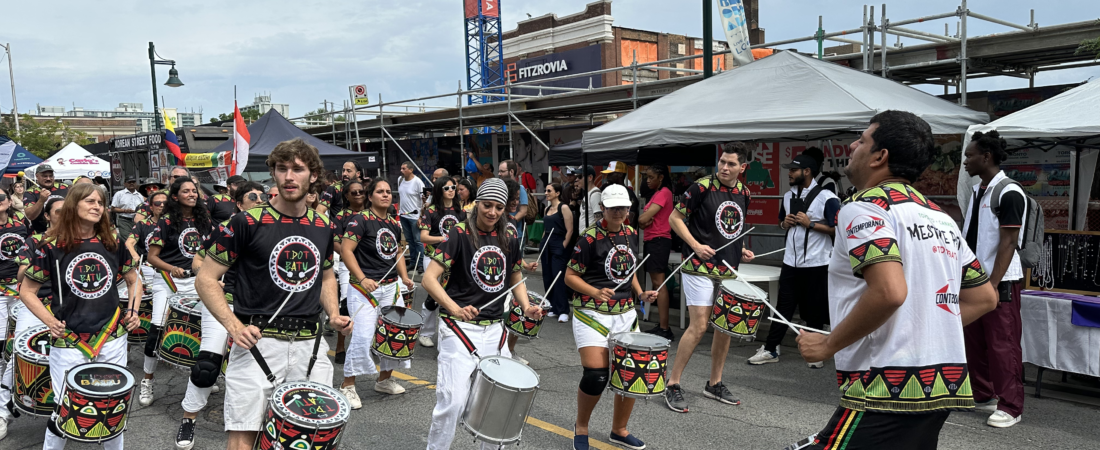
Samba reggae has a problem that a guitar does not have. You cannot practice it alone in a bedroom. The rhythm is built out of interlocking parts played by separate people on separate drums, which means the smallest useful unit is not one person but a room. Tdot Batu, the Toronto group that has been playing the genre since 2012, describes itself as able to work as a six to eight piece and to swell past twenty. The advertising line for its September workshop is not about technique at all. It is about arithmetic: feel what 20 drums sound like in one room.
That is the actual subject here. A beginner workshop in a genre like this is not outreach bolted onto the side of a performing group. It is the mechanism by which the form reproduces itself, because a bateria that cannot recruit twenty people cannot exist.
What the September samba reggae workshop in Toronto involves
The session is listed by Pato Irie, credited on the listing as Tdot Batu’s director. The published details are narrow and specific, which is useful, because it means a reader can decide without guessing.
| Detail | What the listing states |
|---|---|
| Date | Saturday, September 26, 2026 |
| Time | 2 PM to 4 PM, two hours |
| Venue | Geary Ave Rehearsal Studios, 330 Geary Avenue, Toronto, ON M6H 2C7 |
| Level | Beginners, no experience needed, all levels welcome |
| Instruments | Drums provided |
| Bring | Water bottle, comfortable clothes, ear protection recommended |
| Advertised price | Early bird $50 |
| Tickets | On sale from September 1, 2026, on Eventbrite |
| Refunds | None |
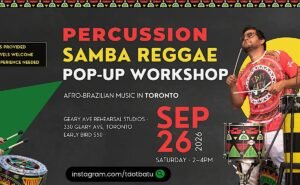
The no refunds line is explicit, and ear protection is a recommendation rather than something supplied. Twenty drums in a rehearsal room is loud in a way that is easy to underestimate.
Who teaches it, and what Tdot Batu is
Tdot Batu has been playing samba reggae in Toronto since 2012, and it has presented the Toronto International Samba Reggae Festival since 2022. The September session sits outside that festival calendar, as a standalone two hour class in a rehearsal studio rather than part of a program.
The instructor is described in a listing on NOW Toronto as “a percussionist from Bahia Brazil with over 30 years of experience teaching playing and studying Samba Reggae”. Tdot Batu’s own public description places the tradition it studies in Salvador, Bahia, where samba reggae emerged in the 1970s and 80s out of samba de roda and the pull of Jamaican roots reggae.
Asked what the session is for, Pato Irie told Raw POV that it suits anyone who wants the experience of playing percussion and of learning more about the culture of Bahia, Brazil, and the Afro-Brazilian origins of Brazilian music. He gave the comment in Portuguese, and it is translated here.
Tdot Batu told Raw POV that it operates as a non-profit organization in Ontario, supporting Bahian music through performance, teaching and the annual festival it presents. That structure is worth noting next to the ticket price, because it is the difference between a workshop that exists to fill a room and one that exists to keep a bateria staffed.
The instruments, and why the count matters
Tdot Batu names the core instruments of its samba reggae band as repiniques, surdos, timbaus, caixas and dobras. Those are not five ways of doing the same job. They are five separate functions, and the reason a beginner session can absorb twenty people at once is that the parts are distributed rather than duplicated.
- Dobra and Surdo. The large bass drums usually carried on a strap or fixed at the floor with a stand.
- Repinique (Repique). The high, sharp drum played by the person calling the band in and out of sections. This is the leader’s instrument.
- Timbau. A tall hand drum, closer in shape to a conga, used for solo and mid range work.
- Caixa. The snare, carrying the steady subdivision that everything else is measured against.
The practical consequence for a newcomer is that you are not going to be asked to play everything. You will be given one function and asked to hold it while nineteen other people hold theirs, which is a genuinely different experience from a music lesson and is closer to being handed one line of a conversation.
Where this fits in Toronto
Brazilian percussion in this city is not a single scene, and it is worth being precise about that. Samba reggae from Bahia is not the Amazonian carimbo brought over by Suraras do Tapajos, and neither is forro, the Northeastern partner dance with its own separate instrumentation and social rules. What they share in Toronto is the workshop as a front door. In each case, the way a person enters is by being put in a room and handed a part.
For the wider picture of where these forms are taught and danced across the country, see our guide to Latin and Brazilian dance in Canada, and our earlier reporting on how samba reggae built a community in Toronto over fourteen years.
Frequently asked questions
Do I need any drumming experience to attend?
No. The listing states the session is for beginners, that no experience is needed, and that all levels are welcome.
Do I need to bring an instrument?
No. The listing states that drums are provided. You are asked to bring a water bottle and comfortable clothes, and ear protection is recommended but not supplied.
When do tickets go on sale and how much are they?
Tickets go on sale on Eventbrite on September 1, 2026. The event poster advertises an early bird price of $50. The listing states that there are no refunds.
What is samba reggae?
It is an Afro-Brazilian percussion genre that emerged in Salvador, Bahia, in the 1970s and 80s, when the city’s blocos afros combined samba de roda with the influence of Jamaican roots reggae. It is associated with ensembles including Olodum and Ile Aiye, both named in the workshop description.
Where exactly is the workshop held?
At 330 Geary Avenue, Toronto, ON M6H 2C7, listed as Geary Ave Rehearsal Studios, from 2 PM to 4 PM on Saturday, September 26, 2026.
Sources and method
Event details, level, what to bring, the two hour duration, the no refunds policy, the on sale date of September 1, 2026 and the venue address come from the event listing on Eventbrite, which is published by the organizer. The early bird price of $50, the line that drums are provided and the “all levels welcome, no experience needed” wording appear on the event poster carried on that listing. The description of Pato Irie as a percussionist from Bahia with more than 30 years of experience is quoted from a separate workshop listing on NOW Toronto. The instrument list and the six to eight piece to twenty plus range come from Tdot Batu’s own public description of the group. The founding year of 2012, and the fact that Tdot Batu has presented the Toronto International Samba Reggae Festival since 2022, come from Raw POV’s earlier reporting, linked above.
The description of Tdot Batu as a non-profit organization in Ontario was given to Raw POV by the organization itself, and is reported here as its own account rather than as a registry finding.
Disclosure: a Raw POV contributor volunteered on the Toronto International Samba Reggae Festival media team during the 2026 edition, and the festival’s website was built by INKA Digital Works, which is connected to this publication. Raw POV has no financial interest in ticket sales for this workshop.