
Statistics Canada asks people how often they feel lonely, and the answers split three ways. Immigrants and non-immigrants report chronic loneliness at almost exactly the same rate. The whole difference sits in the occasional kind, and it narrows with years in Canada without closing.
In the last quarter of 2024, 13.1 per cent of immigrants aged 15 and over told Statistics Canada they always or often feel lonely. Among non-immigrants, the figure was 13.0 per cent. That is a tenth of a percentage point, and the confidence intervals around the two numbers overlap almost completely, so the honest reading is that there is no measurable difference at all.
Move one column over and the picture changes. Asked whether they sometimes feel lonely, 42.7 per cent of immigrants said yes, against 35.0 per cent of non-immigrants. That is a gap of 7.7 points, and this time the confidence intervals do not overlap. The difference is real, and it is not the clinical kind.
What the loneliness numbers actually say
The table below comes from Statistics Canada table 45-10-0049-01, reference period October to December 2024, for Canada excluding the territories. The three columns are the only three answers available, and they sum to 100 within each row, which is what makes them safe to compare side by side.
| Group | Always or often lonely | Sometimes lonely | Rarely or never |
|---|---|---|---|
| Non-immigrants | 13.0% | 35.0% | 52.0% |
| Immigrants | 13.1% | 42.7% | 44.2% |
| All persons 15 and over | 13.4% | 36.9% | 49.7% |
Add the first two columns together and 55.8 per cent of immigrants report some loneliness, against 48.0 per cent of non-immigrants. The difference is 7.8 points, and 7.7 of those points come from the middle column alone. Whatever is happening, it is happening to people who are fine most of the time.
The gap narrows with years in Canada, and does not close
The same table breaks immigrants down by how long they have been in the country, and the two groups do not look alike.
| Group | Always or often lonely | Sometimes lonely | Gap, sometimes lonely |
|---|---|---|---|
| In Canada 10 years or less | 15.8% | 47.4% | 12.4 points |
| In Canada more than 10 years | 12.0% | 40.8% | 5.8 points |
| Non-immigrants | 13.0% | 35.0% | reference |
Among people who arrived within the last decade, occasional loneliness runs 12.4 points above the non-immigrant rate. Among those here longer than ten years, it runs 5.8 points above. The second gap is about 53 per cent smaller than the first, and the confidence intervals for both still sit clear of the non-immigrant figure, so neither has collapsed into noise.
The chronic column behaves differently again. At 15.8 per cent for recent arrivals and 12.0 per cent for the longer settled, the numbers look like a decline, but their confidence intervals overlap the non-immigrant rate in both directions. On this evidence there is no chronic loneliness gap to narrow in the first place.
What the data cannot show
These are two different groups of people measured on the same day, not one group followed over a decade. Someone who arrived in 2022 is not a younger version of someone who arrived in 2010. Age at arrival, language, admission category and who was already here all differ between them, and the survey does not separate those things out. The narrowing is in the data. The reason for it is not.
The table also carries a Latin American breakdown, and we are leaving it out on purpose, which is a shame given how much the Latin American population in Canada repays a closer look. Statistics Canada flags those cells for caution, and the 95 per cent confidence interval around the occasional loneliness figure runs from 18.9 to 40.2 per cent, a span wide enough to contain both the immigrant and the non-immigrant rate. There is no finding there to report, only a number that looks like one.
A Toronto project that put the middle column on a calendar
CARE Experiences began running events at the Celtic Beer House on Yonge Street this month. Claudia Ribeiro, who founded it, told Raw POV in writing that the project is built on what she called lifestyle psychiatry, an approach she described as treating mental health as wider than therapy and medication and taking in sleep, food, physical activity and mindfulness. Her account, translated from Portuguese and edited only for length, sets out the premise plainly.
Many forms of psychological suffering have collective roots and therefore require collective healing, a typically Brazilian way of dealing with what ails us.
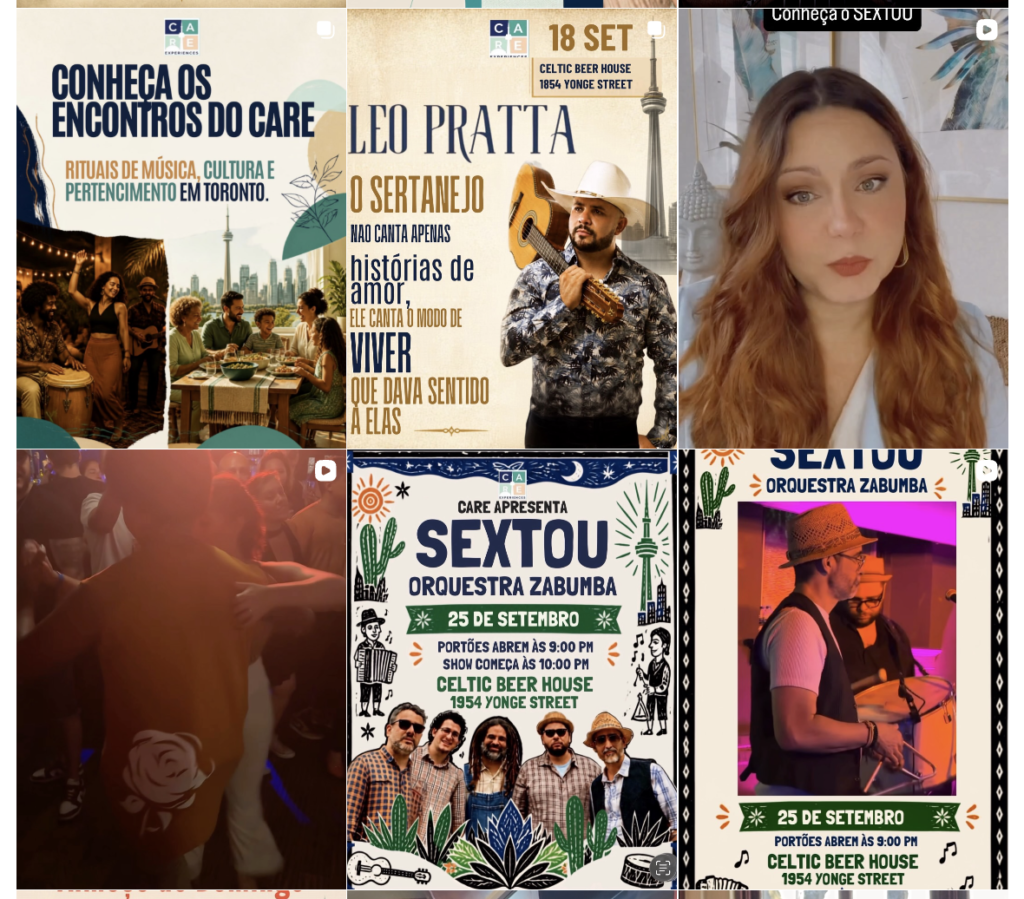
Ribeiro said the first phase concentrates on one pillar, socialisation through art and culture, and that the project is establishing itself in Toronto as a meeting point for the Brazilian community, working against the loneliness of immigration by rebuilding the structures that let belonging, friendship and real bonds form. Those structures are easy to underestimate until you look at what families end up improvising without them. She said later phases are intended to include health programming aimed specifically at women.
Raw POV has not assessed that framework, and nothing in the Statistics Canada figures measures anyone who attends these events. What can be said is narrower and still worth saying: the gap the data actually documents is the occasional kind, among people who are not in crisis and who have loose evenings, and a fixed calendar of places to be is the shape of thing that matches that description.
What is left of the first season, and what it costs
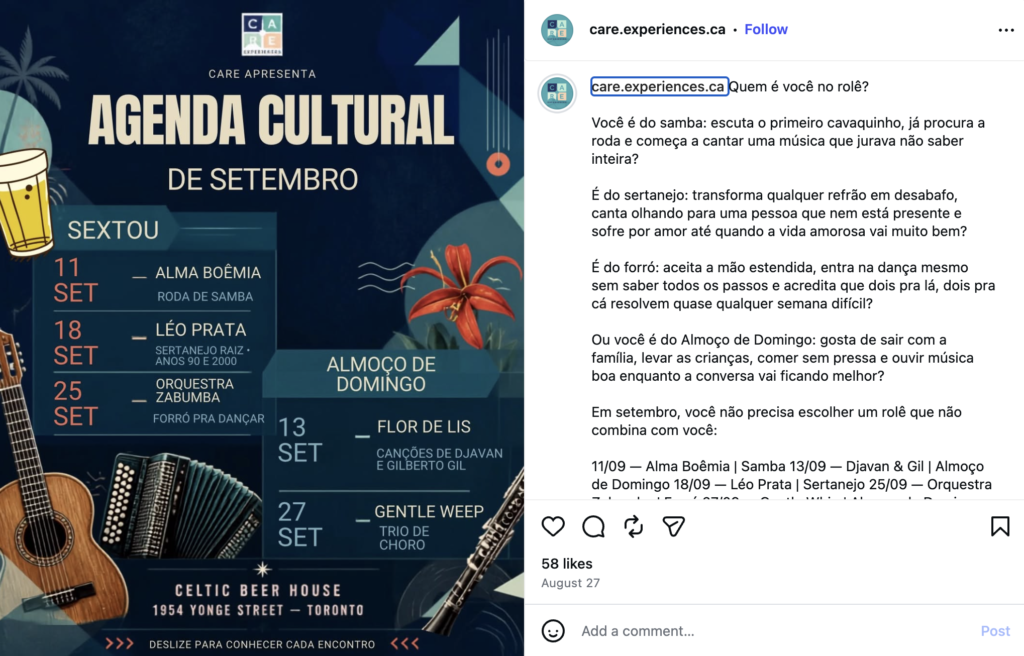
Two events have already happened, a samba circle on 11 September and a Sunday lunch on 13 September, both part of the crowded Brazilian weekend the city saw this month. Three remain, all at the Celtic Beer House, 1954 Yonge Street. Prices below were checked on the ticket page on 14 September and exclude the booking fee, which is $2.00 on the early bird tier and $2.25 on the others.
| Date | Event | Time | Early bird | General | At the door |
|---|---|---|---|---|---|
| Fri 18 Sep | Sertanejo with Léo Pratta | 9:00 to 11:45 pm | $17 | $23 | $29 |
| Fri 25 Sep | Forró with Orquestra Zabumba | 9:00 to 11:45 pm | $17 | $23 | $29 |
| Sun 27 Sep | Choro with Gentle Weep | doors 12 pm, show 1 pm, ends 5 pm | $14 | $17 | $23 |
Deciding late is expensive. On the Friday nights the door price is 70.6 per cent above the early bird tier. On the Sunday it is 64.3 per cent above. The Sunday runs five hours against two hours forty-five on a Friday, which works out at $3.40 an hour on general admission against $8.36, a ratio of about two and a half to one. The Sunday listing advertises art programming, activities for children and family karaoke alongside the music. The Friday nights are a show, food and a bar.
Anyone deciding which Friday to pick might note that forró is the genre this magazine has covered most and the one Canadian search traffic actually asks about, which is a fact about our own audience rather than a recommendation about the music. For the rest of the week there is now an app that tracks where Toronto is dancing.
Frequently asked questions
Are immigrants in Canada lonelier than non-immigrants?
On chronic loneliness, no measurable difference: 13.1 per cent against 13.0 per cent, with overlapping confidence intervals. On occasional loneliness, yes: 42.7 per cent against 35.0 per cent, a gap of 7.7 points.
Does the loneliness gap go away the longer someone lives in Canada?
It gets smaller and does not disappear. Immigrants in Canada more than ten years report occasional loneliness 5.8 points above the non-immigrant rate, against 12.4 points among those here a decade or less. These are different groups measured at the same time, not the same people followed over the years.
Where do these numbers come from?
Statistics Canada table 45-10-0049-01, covering loneliness by gender and other selected sociodemographic characteristics, reference period October to December 2024, for Canada excluding the territories.
What is CARE Experiences?
A Toronto project running cultural gatherings for the Brazilian community, founded by Claudia Ribeiro. It has three events left in its first season, on 18, 25 and 27 September, all at the Celtic Beer House on Yonge Street.
How much do the remaining events cost?
The two Friday nights run from $17 on the early bird tier to $29 at the door. The Sunday lunch runs from $14 to $23. A booking fee of $2.00 or $2.25 applies on top.
Sources and method
All loneliness figures come from Statistics Canada table 45-10-0049-01, downloaded in full and read from the table rather than from a summary. The reference period is October to December 2024, which is the most recent in the series. Percentages are for all persons aged 15 and over.
Statistics Canada publishes the three response shares and the confidence intervals around each. It does not publish the gaps between groups, the ratio between them, the combined any-loneliness figure or the comparison between recent and longer settled immigrants. Those are our calculations, and every one of them was checked against the published confidence intervals before being described as a difference.
Event details, times and prices were read on the organiser’s ticket page on 14 September 2026 and may change. Claudia Ribeiro provided her account of the project in writing, in Portuguese; it has been translated and edited only for length and clarity. Raw POV has not evaluated the project’s methods or results, and the survey data describes the country, not anyone who attends these events. Spellings of performer names were confirmed with the organiser.