Samba reggae was born in Salvador, Bahia, in the 1970s and 80s, out of samba de roda and the pull of Jamaican roots reggae. In June 2026 it closed a stretch of Dundas Street West for the fifth year running, in a festival that took one Toronto percussion group fourteen years to make possible. This is what the documented record shows about how that community was built.
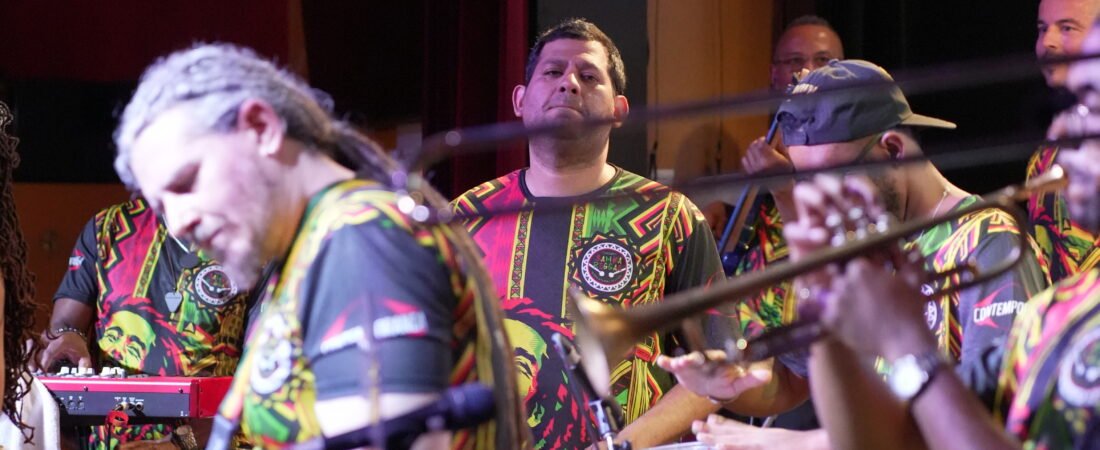
On the afternoon of Saturday, June 6, dozens of drummers formed up at Lansdowne Avenue and Dundas Street West, joined by a dance group and more than 20 brass players, and marched west through the Do West Fest crowd playing Bob Marley tunes on Bahian drums. Nobody paid to watch. That parade is the most visible ninety minutes of the Toronto International Samba Reggae Festival, and it is also the least representative, because the work that produces it happens over years, in rehearsal rooms and grant applications.
The festival calls itself the only event in Canada dedicated entirely to samba reggae. Raw POV could not find another Canadian festival built around the genre, though absence of evidence is not proof, so take that as the organisers’ claim rather than ours.
Why a Bahian drum festival programmed a Bob Marley tribute
The 2026 theme was a tribute to Bob Marley, which sounds like a booking decision and is actually a history lesson. Samba reggae emerged in Salvador in the 1970s and 80s when the blocos afros of Bahia folded the heavy pulse of Jamaican roots reggae into samba de roda, and the result became a vehicle for Black pride and social commentary in a city where most of the population is Afro-Brazilian. Marley was among the genre’s stated inspirations from the beginning.
So the tribute runs in the direction you might not expect. It is not a Brazilian group covering a Jamaican icon for the anniversary. It is a genre returning a debt to one of the sounds that made it, in a third country, in front of an audience that mostly came for the drums.
The ensembles named as inspirations in Tdot Batu’s own organisational history are the ones you would expect from anyone who knows Salvador: Olodum, Ile Aiye and Timbalada. The 2022 edition also brought over Adriana Portela, founder of Dida, the first all women samba reggae ensemble in Bahia. That lineage matters for what happens in Toronto, because it is the difference between importing a rhythm and importing the reason the rhythm exists.
Fourteen years of shows before there was a festival
Tdot Batu Percussive Arts was founded in 2012 by Brazilian born Patricio Martinez, known as Mestre Pato, with a mandate to promote Brazilian music in Canada through percussive arts and samba reggae specifically. It started as a self presenting group, meaning it put on its own shows and nobody else’s.
From 2017 it began presenting other artists at Toronto venues including Lula Lounge and The Garrison, with performers such as Baque de Bamba, A Fantasia Bateria, Aline Morales and Rommel Ribeiro. Over the same period the group played its way into the city’s existing festival calendar: Muhtadi’s International Drumming Festival, Afrofest, Beaches Jazz Festival, Luminato, MixTO, Lulaworld, Pedestrian Sundays in Kensington and Do West Fest. It also ran regular percussion workshops for mixed skill levels, covering everything from samba reggae to rumba.
Ten years passed between that founding and the first festival edition in 2022. The sequence is worth naming plainly, because it is the part that never appears in a listings page: audience first, then partnerships, then a festival. Tdot Batu partnered with Lula Music and Arts Centre for the inaugural edition, which ran parades and street performances at the Big on Bloor Festival with support from the Canada Council for the Arts. In 2023 and 2024 the group took over as primary presenter, and it now handles planning, budgeting and execution for the whole thing.
The five editions, counted from the documented record
The table below is Raw POV’s own tally, assembled from Tdot Batu’s organisational history and the 2026 press release. No single source publishes it this way.
| Edition | Role of Tdot Batu | Named guest artists in the record |
|---|---|---|
| 2022 (first) | Co-presenter with Lula Music and Arts Centre | Adriana Portela, Marcos da Costa, Mestre Memeu |
| 2023 and 2024 | Primary presenter | Carlos, Dandha da Hora, Sandoval Melodia, Mestre Eden Paulo, Japa System, Mateus Vidal, Cra Rosa, plus Canadian artists Jerusa Leao, Salviano Pessoa and Cibele Iglesias |
| 2025 | Not described in the material Raw POV reviewed | Not documented here |
| 2026 (fifth) | Presenter, in collaboration with Lula Music and Arts Centre | Tambores e Samba, Corcovado, Jahgun, Rainha Vania Oliveira, Mestre Geraldo Marques, Pato Irie |
Counting only the performers named in those documents, at least 19 artists and ensembles have been programmed across the editions on record, from Brazil, Canada, France and the wider diaspora. The 2026 edition is billed as the fifth, which fits five consecutive years starting in 2022, but Raw POV did not find a description of the 2025 programme in the material available, so that row stays empty rather than guessed.
What the fifth edition actually put on the street
Four days, four different kinds of access. The times below come from the festival’s internal media schedule, which the public press release did not include.
| Date | What | Where | Access |
|---|---|---|---|
| Thu, June 4 | Opening night, 9.30pm to 1am: Tambores e Samba and Corcovado, then a late all-star set | Lula Lounge | Ticketed |
| Fri, June 5 | Percussion and dance workshops from 11am, led by guest artists from Bahia and France | Lula Lounge | Advance registration, own instrument |
| Sat, June 6 | Street parade, 12.30pm to 2pm, with dancers and 20+ brass; main stage set at 8pm | Lansdowne Ave and Dundas St W, Do West Fest | Free |
| Sun, June 7 | Closing performance, 5pm to 6pm, with dancers and brass, followed by a closing party | Dundas St W stage, then BSMT 254 | Free |
Two of the four days carried no ticket at all. The press release put it in a sentence that no arts marketing department would normally approve: “It is loud, it is live, and it is free.” That is a programming choice with a cost attached, and it is the one that decides who ends up in the audience.
Where the money comes from, and what that buys
The 2026 edition lists support from the Canada Council for the Arts, the Ontario Arts Council, the Toronto Arts Council, Canadian Heritage and Do West Fest as community partner. Three levels of government, in other words, plus a neighbourhood street festival that supplies the crowd.
Public arts funding is what makes a free parade possible for a genre with no commercial radio presence in Canada. It also means the festival’s continuity depends on grant cycles rather than ticket revenue, which is a structural fact about most diaspora arts programming in this country and not a complaint about anyone’s decisions. The organisers also credit Lula Music and Arts Centre, and specifically Lula Lounge director and manager Tracy Jenkins, for support through the festival’s growth.
Here is the plain version of what fourteen years produced: a Toronto audience that knows what a surdo is, a route through a neighbourhood that expects the noise every June, and a pipeline that brings Bahian mestres to a Canadian street. Integration, in this case, did not mean the rhythm getting quieter to fit the city. It meant the city making room for it, one edition at a time.
Frequently asked questions
What is samba reggae?
Samba reggae is an Afro-Brazilian percussion genre that emerged in Salvador, Bahia, in the 1970s and 80s, when the city’s blocos afros combined samba de roda with the influence of Jamaican roots reggae. It became closely tied to Black pride and social commentary in Bahia, and is associated with ensembles including Olodum, Ile Aiye and Timbalada.
When is the Toronto International Samba Reggae Festival held?
The 2026 edition, its fifth, ran from June 4 to 7, 2026, across Lula Lounge and the Do West Fest stretch of Dundas Street West. The festival has been held annually since its first edition in 2022.
Is the samba reggae street parade in Toronto free?
Yes. The Saturday parade on Dundas Street West and the weekend main stage performances at Do West Fest were free and open to everyone, with no ticket required. Opening night at Lula Lounge was ticketed, and the workshops required advance registration.
Who organises the festival?
It is presented by Tdot Batu Percussive Arts, a Toronto percussion organisation founded in 2012 by Patricio Martinez, known as Mestre Pato, in collaboration with Lula Music and Arts Centre. Tdot Batu has been the primary presenter since 2023.
Can beginners join the samba reggae workshops?
The 2026 workshops were described as intensive sessions for experienced samba reggae drummers, with participants asked to bring their own instrument and register in advance. Tdot Batu separately runs regular percussion workshops for a range of skill levels through the year.
Sources and method
Programme details for the 2026 edition, including dates, venues, lineup, access and funders, come from the festival’s official press release for the fifth edition and from the Toronto International Samba Reggae Festival website. The single quoted sentence is from that press release. The organisational history, founding date, venue and festival appearances, workshop programme, artistic inspirations and the artist lineups for the 2022, 2023 and 2024 editions come from Tdot Batu’s own written organisational history, submitted as part of a public arts funding application. Scheduled times in the four day table come from the festival’s internal media team schedule for June 2026, which was not published in the press release. The count of at least 19 named artists and ensembles, the ten year gap between the group’s founding in 2012 and the first edition in 2022, and the observation that two of the four days were free are Raw POV’s own calculations from the documents above, not figures published by any source. Raw POV did not independently verify each performance against the announced programme, and where the material was silent, as with the 2025 edition, this article says so rather than filling the gap. Disclosure: a Raw POV contributor volunteered on the festival’s media team during the 2026 edition, and the festival’s website was built by INKA Digital Works, which is connected to this publication.
Read more from Raw POV: the Indigenous warriors bringing Amazonian carimbo to Toronto, the Forro Roots Weekend workshops in Toronto, and our complete guide to Latin and Brazilian dance in Canada. Or browse all Raw POV Culture coverage.