
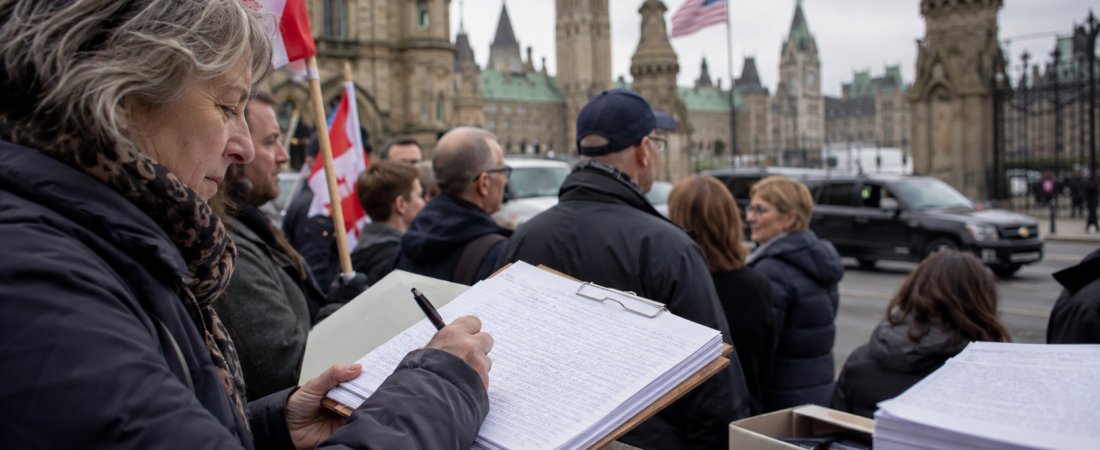
More than 57,000 people have signed a petition asking Ottawa to expel the U.S. ambassador. Elizabeth May will present it to the House of Commons this fall. Here is what a petition can actually do, and what only the government can.
A petition started by a woman in Calgary has now collected more than 57,000 signatures, all of them asking the Canadian government to do something it has done only a handful of times in modern history: declare a foreign ambassador persona non grata and send him home.
The ambassador is Pete Hoekstra, the United States envoy to Canada. Green Party Leader Elizabeth May has agreed to present the petition to the House of Commons when Parliament returns in the fall. The story was reported by Sarah Ritchie of The Canadian Press and published by Global News on 12 August 2026.
The signatures are the easy part of this story. The mechanics are the interesting part, and they are almost entirely missing from the conversation online, where a great many people appear to believe that a petition, if large enough, removes an ambassador. It does not. Here is how it actually works.
What the petition says
The petition accuses Hoekstra of repeated interventions in Canadian political discourse that it describes as inconsistent with diplomatic protocol. It asks for two things: that he be declared persona non grata and removed from his post, and that a parliamentary committee examine U.S. diplomatic interference in Canadian affairs.
Two episodes sit behind it. Hoekstra has said that the annexation of Canada by the United States would make for a “great discussion” between Prime Minister Mark Carney and President Donald Trump. And in September, speaking to an audience in Halifax, he said he was disappointed and frustrated by what he characterised as an anti-American tone during the federal election campaign.
Asked about the petition, a spokesperson for the U.S. embassy declined to comment substantively, saying only that the embassy was aware of it.
What “persona non grata” actually means
This is the part worth understanding properly, because it is both more powerful and more limited than most people assume.
Under Article 9 of the Vienna Convention on Diplomatic Relations, the 1961 treaty that governs diplomatic conduct between states, and to which both Canada and the United States are parties, a host country may at any time declare any member of a foreign mission persona non grata. It does not have to explain why. It does not have to prove anything. It does not have to wait for the sending state to agree.
The sending state must then recall the person or end their functions. If it refuses, the host country can simply stop recognising them as a diplomat, at which point their immunity and their job cease to exist in any practical sense.
So the power is real and it is unilateral. But notice who holds it. It sits with the executive, in Canada’s case, with the government through Global Affairs Canada, exercised as a Crown prerogative in foreign affairs. It does not sit with the House of Commons, it does not sit with a committee, and it does not sit with 57,000 signatures.
What presenting a petition to Parliament does
Petitions to the House of Commons are a genuine procedural instrument, not a symbolic one, but their effect is a required answer, not a required action.
Canada accepts both paper petitions, which need at least 25 signatures, and electronic petitions, which need an MP’s sponsorship and at least 500 verified signatures within 120 days. Once a petition is certified and presented by a Member of Parliament, the government is obliged to table a response, normally within 45 calendar days.
That is the whole of it. A response. The government can respond by declining, at length and politely, and the process is complete. What a petition of this size does is force a minister to put a position on the public record, in writing, with a date on it, and to do so in a fall sitting when Canada, U.S. relations will already be under scrutiny. That is not nothing. It is also not an expulsion.
The precedents, and why they matter here
Canada has used the persona non grata declaration recently, twice, and both cases are instructive because of how serious the underlying allegations were.
In 2023, Canada expelled Chinese diplomat Zhao Wei following allegations of targeting a sitting Member of Parliament and his family. In 2024, Canada expelled six Indian diplomats amid allegations connected to a criminal investigation on Canadian soil.
Both involved alleged conduct against people in Canada. Neither turned on a diplomat saying things Canadians disliked.
That is the threshold question the government will face when it responds. Diplomats are expected to observe restraint in the domestic politics of their host country, Article 41 of the same Vienna Convention states the duty not to interfere in internal affairs. But “interference” as a legal concept and “undiplomatic commentary” as a political grievance are not the same thing, and the distance between them is exactly where this petition sits.
Why 57,000 signatures is still a real number
It would be easy to conclude from all of the above that the petition is theatre. That reading misses what the number is measuring.
Online petitions are a poor instrument for changing policy and a decent instrument for measuring intensity. Fifty-seven thousand signatures on a question of diplomatic protocol, a subject that ordinarily interests almost no one outside the foreign service, is a signal about the temperature of Canadian public opinion toward the United States at a moment when sovereignty, tariffs and annexation rhetoric have moved from the margins of Canadian politics to its centre.
A government that declines to expel an ambassador can still be substantially constrained by knowing that number exists. Diplomatic relationships are managed in the space between what a country says publicly and what it accepts privately, and public tolerance is one of the inputs.
There is also a second, quieter request in the petition that has attracted far less attention than the expulsion demand: a parliamentary committee review of U.S. diplomatic interference. That is a considerably more plausible outcome than an expulsion, it is within Parliament’s own power rather than the government’s, and it would produce testimony, documents and a public record. If anything durable comes out of this petition, it is more likely to come from that clause.
What to watch next
- The fall sitting. May must present the petition for the 45-day response clock to start.
- The wording of the government’s response. Whether it defends diplomatic norms in general terms or addresses Hoekstra’s remarks specifically will tell you how Ottawa has decided to handle this.
- Committee referral. Whether any Commons committee, foreign affairs being the obvious candidate, takes up the interference question independently of the expulsion demand.
- Whether the ambassador comments again. The petition’s central claim is that the pattern is repeated. Another intervention would strengthen it considerably.
Frequently asked questions
Can a petition remove a foreign ambassador from Canada?
No. Only the Government of Canada can declare a diplomat persona non grata, exercised through Global Affairs Canada as a Crown prerogative. A petition presented in the House of Commons obliges the government to table a written response, normally within 45 calendar days, but does not compel any action.
What does persona non grata mean?
Under Article 9 of the Vienna Convention on Diplomatic Relations (1961), a host state may declare any member of a foreign diplomatic mission unwelcome at any time, without giving reasons. The sending state must then recall them or end their functions, or they lose diplomatic status.
Why do people want Pete Hoekstra expelled?
The petition cites what it calls repeated interventions in Canadian political discourse, including his comment that the annexation of Canada by the United States would be a “great discussion” for the prime minister and president, and remarks in Halifax criticising an anti-American tone in the federal election campaign.
Has Canada expelled diplomats before?
Yes. Canada expelled Chinese diplomat Zhao Wei in 2023 over allegations of targeting a Member of Parliament, and six Indian diplomats in 2024 in connection with a criminal investigation in Canada.
How many signatures does a Commons petition need?
Paper petitions require at least 25 signatures. Electronic petitions require an MP sponsor and at least 500 verified signatures within 120 days. This petition has surpassed 57,000.
Sources and method
The petition figures, the parties involved and the quoted remarks in this article are reported by Sarah Ritchie of The Canadian Press, published by Global News on 12 August 2026 and available here. The explanation of the Vienna Convention on Diplomatic Relations (Articles 9 and 41), Canadian House of Commons petition thresholds and response timelines, and the 2023 and 2024 expulsion precedents is Raw POV’s own, drawn from the public treaty text and parliamentary procedure. Raw POV did not independently contact the petitioner, the Green Party or the U.S. embassy.
Read more from Raw POV: our Society coverage and how Latin American culture is reshaping the Canadian mosaic.