Every curling stone in serious competition is cut from rock taken out of two places on earth: an uninhabited Scottish island that is also a protected bird colony, and a quarry on the coast of North Wales. Canada has more than 800 affiliated curling clubs and a record 158,199 registered curlers. Nobody publishes how much granite that adds up to, so we worked it out.
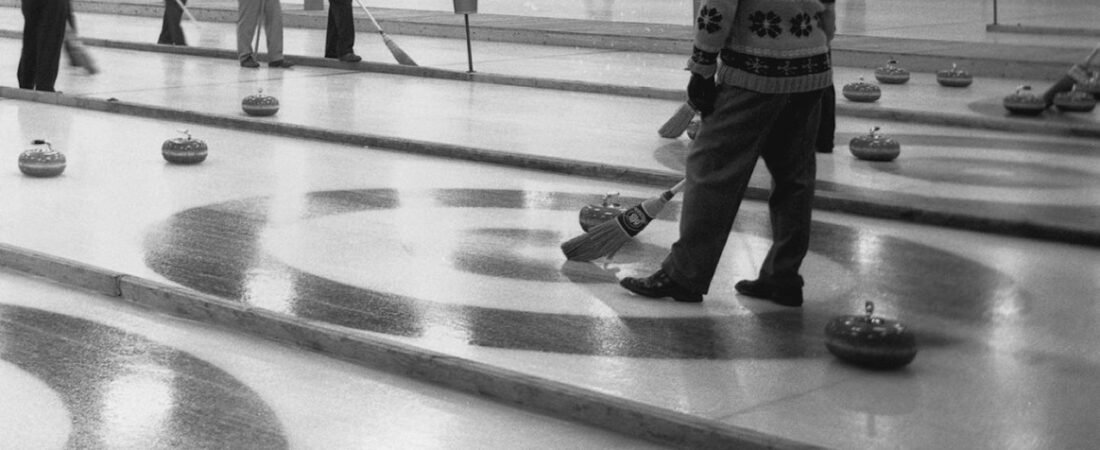
The rule that creates the demand is short and rarely quoted. Section 4 of Curling Canada’s rules for general play says that two sets of eight stones shall be provided for each sheet of play. Sixteen stones, per sheet, every sheet, before a single game is played. The same section caps a stone at 44 pounds (19.96 kilograms) including handle and bolt, sets a floor of 38.5 pounds (17.46 kilograms), and limits it to a circumference of 36 inches with a minimum height of 4.5 inches.
Multiply that by the size of Canadian curling and the numbers stop being small. Curling Canada’s 2025 annual report counts more than 800 affiliated clubs, 14 provincial and territorial associations, and 158,199 people registered as club curlers, which the report describes as a record and up 4.5 percent on the previous season. It also estimates that more than two million Canadians play casually at least once a season.
What more than 800 clubs need, in stones and in tonnes
Curling Canada does not publish a national count of ice sheets, so an exact figure is not available. What can be established is a floor. If every one of those 800-plus clubs had exactly one sheet, which no Canadian curler would recognise as realistic, the club system would still hold 12,800 stones. At the rulebook’s 19.96 kilogram ceiling that is 255 tonnes of imported rock sitting in Canadian clubs. Most clubs have several sheets, so the real figure is a multiple of that.
Here is the arithmetic laid out. The last column compares each scenario to the 132 stones that Team GB says were used across the entire curling tournament at the 2022 Beijing Winter Olympics.
| If the average club has | Stones in play | Tonnes of granite | Registered curlers per stone | Beijing 2022 tournaments’ worth |
|---|---|---|---|---|
| 1 sheet (a hard floor) | 12,800 | 255 | 12.4 | 97 |
| 2 sheets | 25,600 | 511 | 6.2 | 194 |
| 4 sheets | 51,200 | 1,022 | 3.1 | 388 |
| 6 sheets | 76,800 | 1,533 | 2.1 | 582 |
Even the floor row is striking. Canada’s clubs hold roughly 97 times the number of stones that an entire Olympic curling tournament requires, and that is the least generous assumption available.
One province gives a sense of the density behind the national figure. Curl BC’s 2025-26 annual report puts its membership at 24,000 and counts 86 curling facilities in British Columbia, 83 of them members. That works out to about 279 curlers per facility. Nationally, 158,199 registered curlers across 800 clubs averages 198 per club.
The island: 99.94 hectares, 23,000 pairs of gannets, and a narrow window
Ailsa Craig sits in the Firth of Clyde, 15 kilometres west of Girvan. NatureScot’s official citation gives its area as 99.94 hectares and describes it as a plug of Palaeogene microgranite formed between 58 and 60 million years ago. It was first notified as a Site of Special Scientific Interest in 1957, re-notified in 1984, and reviewed in 2008. It is also a Special Protection Area. The site management statement records a gannetry of 23,000 pairs, equivalent at the time of writing to 14 percent of the EU breeding population, plus around 65,000 individual seabirds during the breeding season.
That is the constraint. The same document is one of the few places where the curling connection appears in an official register rather than in a feature article. It notes that the island has been known as a source of curling stone granite since the 1880s, and that extraction continues, in terms it states plainly: “modest demand is met by removal of loose boulders, which requires no blasting”. Any extension of the worked area, it adds, needs planning approval.
The island belongs to the Marquess of Ailsa. In March 2004 the 8th Marquess leased the land to the Royal Society for the Protection of Birds until 2050, and the RSPB manages it as a nature reserve. That lease has 24 years left to run from 2026. Harvesting happens roughly once a decade, so on that cadence there are about two more collections inside the current lease term. The island also has a rat eradication story attached to it: brown rats introduced in the late 19th century wiped out the puffin colony entirely, and after a programme begun by a working group formed in 1989 the rats are gone.
Kays of Scotland, in Mauchline, Ayrshire, works the rock. The firm dates itself to 1851, which makes 2026 its 175th year, and states on its own site that it holds the sole lease to the only known source of Ailsa Craig Common Green and Ailsa Craig Blue Hone granite. It describes its workforce as a small team of craftsmen with a field sales manager and back office staff. Blue Hone goes into the running edge, the narrow band that actually touches the ice. Common Green forms the body, because it copes better with heat transfer and condensation and does not splinter when struck. Kays says its stones were chosen for the last five Winter Olympic Games, and both Team GB and the geologist Hobart King date the firm’s Olympic supply to the 1924 Chamonix Games.
The Welsh half, and the Ontario factory
The second source is Trefor, on the coast of North Wales. Canada Curling Stone Company, based at Komoka in southwestern Ontario and manufacturing since 1992, states that it holds exclusive rights to Trefor granite and is the only company in the world making new stones from it. Trefor stones went to the 2002 Salt Lake City Winter Olympics, the one Games in recent memory not supplied from Ailsa Craig.
The Ontario company also sells remanufactured stones, fitted with Blue Hone running surfaces and reprofiled strike bands, and a 20 pound composite junior stone. That matters more than it sounds, and it is the part of the supply question most coverage skips.
Why a once-a-decade quarry can supply a whole sport
A curling stone is not consumed. It is dressed, played, worn down over years, then re-dressed: the running surface replaced with a fresh insert, the strike band recut, the same body sent back to the ice. A club that buys sixteen stones is buying an asset with a working life measured in decades, not seasons. The demand that reaches the quarry is replacement demand from a slowly growing installed base, not annual consumption of 51,000 stones.
Which is the honest answer to the alarming version of this story. Two quarries supplying a global sport sounds precarious. In practice the constraint is real but slow, and the numbers that make it manageable are the same ones that make the tonnage large: stones stay in service, refurbishment extends them further, and the harvest window only has to keep pace with attrition. The catch is that the pace is set by a bird colony’s breeding calendar and a lease that ends in 2050, not by how many people take up the sport.
The measurements, converted
Rulebooks state circumference. Nobody thinks in circumference. Converted, the 36 inch (91.44 centimetre) maximum works out to a diameter of 29.11 centimetres. Team GB describes a typical stone as 278 millimetres wide and 136 millimetres high, which sits inside the rulebook on both counts: that width implies a circumference of 87.3 centimetres, under the 91.44 limit, and that height clears the 11.43 centimetre minimum.
The weight band is wider than most players realise. Between the 17.46 kilogram floor and the 19.96 kilogram ceiling there is 2.5 kilograms of legal range per stone, or 14.3 percent measured against the lighter end. Across a full set of sixteen, two entirely legal sets can differ by 40 kilograms.
Frequently asked questions
Where do curling stones come from? Two quarries. Ailsa Craig, an island in the Firth of Clyde off south west Scotland, supplies Blue Hone and Common Green granite, worked by Kays of Scotland. Trefor, on the North Wales coast, supplies the granite used by Canada Curling Stone Company in Ontario.
How many stones does a curling sheet need? Sixteen. Curling Canada’s rules for general play require two sets of eight stones for each sheet of play.
How much does a curling stone weigh? Between 38.5 and 44 pounds (17.46 to 19.96 kilograms) including the handle and bolt, under the same rules. Maximum circumference is 36 inches, which is a diameter of about 29.1 centimetres, and minimum height is 4.5 inches.
How often is granite taken off Ailsa Craig? Roughly once a decade. The island is a Site of Special Scientific Interest and a Special Protection Area, leased to the RSPB until 2050 and managed as a seabird reserve, which constrains when and how material can be removed.
How many people curl in Canada? Curling Canada’s 2025 annual report records 158,199 registered curlers at affiliated clubs, which it calls a record, and estimates more than two million Canadians play casually at least once per season.
Sources and method
From the sources. Stone specifications and the sixteen-stones-per-sheet requirement come from section 4 of Curling Canada’s Rules of Curling for General Play, the edition covering September 2022 to August 2026. Club, membership and participation figures are from the Curling Canada 2025 Annual Report. British Columbia figures are from the Curl BC 2025-26 Annual Report. The island’s area, designation history, geology, seabird numbers, RSPB lease, rat eradication and the passage on granite extraction are from NatureScot’s SSSI citation and site management statement for Ailsa Craig. Company claims about granite rights, materials and workforce are from Kays of Scotland’s own pages on the firm and Ailsa Craig granite, and from Canada Curling Stone Company. The 132-stone Beijing figure, the typical stone dimensions and the 1924 Chamonix date are from Team GB, published 17 November 2024, with the Chamonix date and the 2002 Salt Lake City supply corroborated by Hobart M. King at Geology.com. Julie Leibach’s 2014 piece for Science Friday is the source for the once-a-decade harvesting cadence and for Kays’ share of the new stone market at that time. Managing director Jim English gave the export figure of 70 countries to Euronews in January 2022.
Our own analysis. Every figure in the scenario table is ours. No source publishes a national count of stones or of ice sheets in Canada, so we built the table from two published numbers, more than 800 affiliated clubs and sixteen stones per sheet, and stated the sheets-per-club assumption in each row rather than picking one and presenting it as fact. Tonnage uses the rulebook’s 19.96 kilogram maximum, so those columns are upper bounds for a given stone count. The comparison to Beijing 2022 divides each row by 132. The diameter conversion (29.11 centimetres from a 91.44 centimetre circumference), the check that Team GB’s typical stone fits inside the rulebook, the 2.5 kilogram weight tolerance and its 14.3 percent expression, the 40 kilogram spread across a set of sixteen, the per-club and per-facility averages, and the count of 24 years remaining on the RSPB lease are all our calculations from the cited figures.
What we could not settle. Two things. First, published accounts of harvest years do not agree: several secondary reports describe a 2013 collection of about 2,000 tonnes, while Team GB gives 2020 as the most recent harvest. We have not used a harvest tonnage anywhere in this article, and we describe the cadence only as roughly once a decade, which every source we found agrees on. Second, NatureScot’s site management statement was last reviewed in 2008 and describes extraction as removal of loose boulders requiring no blasting; later press accounts of harvesting describe a gas charge used to free Blue Hone from the rock face. We could not locate a more recent official statement, so we have quoted the 2008 document as what the public register says and flagged that the published descriptions differ. We make no claim about current practice beyond that.
Related Raw POV coverage: how lacrosse went from exclusion to national sport in Canada, the small-sided game now played by 232 teams across Canada, and what happens when you re-cut a sport’s official numbers per capita.