Bolivian dress is having its widest international run in decades, from a Paris art foundation to a skate collective in Cochabamba. Bolivia’s own statistics office says the share of the population claiming an indigenous identity has fallen to 38.7 percent, the lowest any census has recorded. Both statements are accurate, and the reason they can hold at the same time sits in the fine print of how the question was asked.
On 28 August 2025, the Instituto Nacional de Estadística released the self-identification results of Bolivia’s 2024 census. Of 11,365,333 inhabitants, 4,302,484 declared themselves part of an indigenous, originary or campesino nation or people, or Afro-Bolivian. INE put that at 38.7 percent, against 41 percent in 2012 and 62 percent in 2001. The coverage that followed, in Bolivia and abroad, read it as a long decline.
Read as people rather than as percentages, the same data moves the other way. The 41 percent recorded in 2012 was 2,806,592 individuals. The 38.7 percent recorded in 2024 is 4,302,484. That is 1,495,892 more people declaring an indigenous identity, a rise of 53 percent, at the same time as the share fell by 2.3 points.
The share fell. The head count did not.
The gap is not a mystery, but it is rarely stated. The 2001 and 2012 questions were put to the population aged 15 and over, and the 62 and 41 percent figures are shares of that group. The 2024 figure, as INE published it and as the press repeated it, is set against the total population of all ages. Two of the three numbers in the famous sequence are not measuring the same universe.
There is a second detail worth checking with a calculator. Divide 4,302,484 by 11,365,333 and you get 37.9 percent, not 38.7. To produce 38.7 percent the denominator has to be roughly 11,117,530, about 248,000 fewer people than the population INE reported in the same release. Put the other way, 38.7 percent of 11,365,333 would be about 4,398,400 people, some 95,900 more than the published count. INE’s summary does not state which universe the percentage uses, and we could not resolve it from the material the institute has published online.
Here is the full measurement series, with the instrument and the base each figure came from. The last column is ours, not INE’s.
| Year | Instrument | Share reported | People counted | Base the share refers to |
|---|---|---|---|---|
| 2001 | Census | 62% | about 3.5 million | Population aged 15 and over |
| 2012 | Census | 41% | 2,806,592 | Population aged 15 and over |
| 2018 | Household survey | 34% | not given in the release | Survey sample |
| 2021 | Household survey | 26.5% | not given in the release | Survey sample |
| 2024 | Census | 38.7% | 4,302,484 | Not stated in the release |
Laid out like that, the line is not a slope. Between the two most recent measurements, the 2021 household survey and the 2024 census, the reported share rose by 12.2 points. That is the largest single movement anywhere in the series, and it points up. Whether it means anything is a separate question, because a census and a household survey are different instruments with different sample logic, which is exactly the point.
Two nations hold three quarters of the total
Inside the 4,302,484, the distribution is steep. The Quechua nation accounts for 1,646,811 people and the Aymara for 1,595,045. Together that is 3,241,856, or 75.3 percent of everyone who declared. The Guaraní, third by size, come to 103,712, which is 2.4 percent. At the other end, the census records 478 Yuqui, 228 Yaminawa, 72 Machineri and 14 Toromona. Those four peoples together are 792 people, 0.018 percent of the declared total. Another 943 residents identified with an indigenous people from outside Bolivia, and 544,984, or 4.8 percent of the population, landed in a category INE calls “other declarations”.
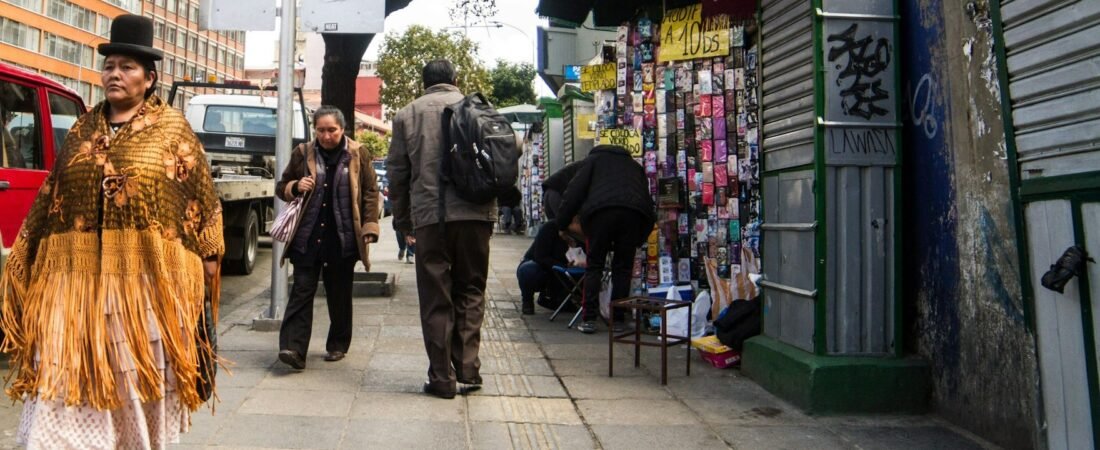
That distribution matters for the garment. The pollera, the manta and the bowler hat are worn overwhelmingly by Aymara and Quechua women in the western highlands and the cities built on them, which means the most visible indigenous dress in the country sits squarely inside the two categories that hold three quarters of the count. The dress is not a minority practice inside the data. It is the majority case.
Why a declaration is not a culture
The anthropologist Andrew Canessa, of the University of Essex, made the useful distinction almost twenty years ago, in a 2007 paper on self-identification in Bolivia. Working in an Aymara-speaking community where every objective marker of indigeneity was present, he found people who did not describe themselves that way, and he documented the reverse case too: people recorded as indigenous in the census who did not claim it, and people claiming it without the ethnolinguistic markers. His conclusion was that self-identification is a political act performed at a particular moment, not a reading of what someone speaks, wears or eats.
Bolivian commentators reached for similar explanations when the 2024 numbers landed. Speaking to the news agency EFE, the historian Pedro Portugal argued that many Bolivians now experience the label as a form of segregation rather than an advantage. Miguel Vargas, director of the research centre Cejis, pointed instead to migration, urban expansion, wildfires and displacement from territories, and warned that small peoples such as the Araona and the Ayoreo are exposed. Those are two different accounts of the same fall, and neither is a claim that fewer people wear the pollera.
Statistics Canada documents the same problem, in its own words
This is not a Bolivian peculiarity, and the clearest published proof of that comes from Canada. For the 2021 Census, Statistics Canada removed the 28 examples that had been printed on the ethnic or cultural origin question in 2016 and replaced them with a description plus an online list of more than 500. The agency’s technical report explains why, citing its own 2019 Census Test: “respondents were more likely to report an origin when it was included in the list of examples”. In that test, “Canadian” drew more than twice as many responses on the version where it appeared as an example than on versions where it did not. Punjabi, Jewish and Acadian all counted higher when listed.
Statistics Canada then says the part that most census coverage leaves out, in Bolivia and here: the new version “will produce results that will not be comparable to the 2016 Census results for many ethnic and cultural origins”. A change in the questionnaire moved the numbers. Nobody’s grandparents changed. It is the same effect Bolivian analysts have argued about since 2012, when the census dropped a read-aloud list of options and offered no mestizo category, and the reported share fell 21 points in eleven years.
The other ledger, and it disagrees with itself
If the census is one way of counting who is indigenous, the festival economy is another, and it is denominated in money rather than in declarations. The Fiesta del Gran Poder in La Paz, inscribed by UNESCO on the Representative List of the Intangible Cultural Heritage of Humanity in 2019, is where a large share of the country’s embroidery, jewellery and pollera work is commissioned, worn and paid for.
Two arms of the Bolivian state have put a figure on it, and they are far apart. In July 2026 the Viceministerio de Culturas y Folklore, through vice minister Andrés Zaratti, estimated that the whole 2026 festivity would move about 21 million dollars, naming embroiderers, artisans, musicians, food, hotels, transport and retail as the beneficiaries. In June 2025 the mayor of La Paz, Iván Arias, estimated 65 million dollars for that year and said the figure referred to a single day, the entrada. He gave 50 million for 2022, 58 million for 2023 and 68 million for 2024, and noted his team was still processing the final numbers when he spoke.
Set side by side, the municipal one-day estimate for 2024 is about 3.2 times the national estimate for the whole of the 2026 festivity. Both are official. Neither is published with a method attached.
The participant counts have moved too. The 2026 Promesa, held on 26 July ahead of the entrada on 1 August, was announced with 95,000 folklorists and 35,000 musicians across 74 fraternities. UNESCO’s 2019 inscription file describes 40,000 devotees, 7,000 musicians and 69 fraternities. Seven years apart, the dancer figure is 2.4 times larger and the musician figure 5 times larger. The two counts may well cover different events on different days, which is the honest caveat, and it is also the pattern: every number attached to this culture depends on who is doing the counting and what they were counting for.
One piece of arithmetic neither body published. Take the lower official estimate, 21 million dollars, and divide it by the 130,000 dancers and musicians announced for the same year. That is about 162 dollars of economic movement per participant, for a festivity whose costumes are among the most expensive garments made in the country.
What a pollera costs, and why nobody can tell you today
There is no published price series for cholita dress, which is a real gap given how often the garment is described as an economic engine. The most detailed public itemisation we could find is old. In June 2011 the agency ANF interviewed Tania Chambilla, then a candidate in the Cholita Paceña contest, who put an everyday “de a pie” outfit at 3,500 bolivianos including the silver jewellery that was in fashion that year, and about 2,000 bolivianos without it.
Set that against the wage floor of the same year and the figure gets sharper. Bolivia’s national minimum wage for 2011, fixed by Decreto Supremo 809, was 815.40 bolivianos a month. The outfit Chambilla described therefore cost about 4.3 months of the minimum wage, and that was the version worn to work and to lunches, not the version worn to dance. For scale, the minimum wage for 2026 is 3,300 bolivianos, set by Decreto Supremo 5516 in January.
We have deliberately not converted any of this into dollars. The outfit price and the wage are both in bolivianos, and running a currency conversion across fifteen years would add error without adding meaning. Months of minimum wage is the unit that survives the trip.
The one story about the hat that we could not stand up
Almost every article about cholita dress, including several consulted for this one, tells the same anecdote about the bowler hat: a shipment ordered for British railway workers in Bolivia arrived too small for the men, and a merchant sold them to Aymara women as the latest European fashion. It is a good story. We could not find a primary document behind it, and none of the accounts that repeat it cite one. Even sympathetic write-ups hedge, describing how the hats entered Aymara women’s dress as unresolved. We are flagging it rather than repeating it as fact, because the most quoted claim about this garment appears to rest on nothing published.
What is documented is the rest of the wardrobe’s long entanglement with global trade, which is the argument Vogue Philippines made in April 2026, in a feature by Daniela Monasterios-Tan with photographs by Luisa Dörr that prompted this piece. That report traces the pollera to the pre-colonial urkhu and its pleated form to Spanish colonial rule, notes that contemporary polleras are often cut from imported Chinese fabric, and links the manta to the Manila galleon routes. It also sets out the institutional side: Elvira Espejo Ayca has led the national ethnography museum MUSEF since 2013, the Aymara architect Freddy Mamani was commissioned by the Fondation Cartier in 2025, and the designer Eliana Paco Paredes showed at New York Fashion Week in 2016.
The youngest example is the clearest. Imilla Skate was formed in Cochabamba in 2019 by Daniela Santiváñez and two friends, who skate in polleras. Imilla means girl in both Aymara and Quechua, and was an insult before the collective took it back. Whatever a census form records about them, the skirt is on the board.
What this is actually useful for
If you work with data about people, and particularly if you make decisions from it, the Bolivian case is a clean worked example of something that applies everywhere. A self-identification number is a measurement of a question, not of a population. When it moves, the first thing to check is whether the instrument moved, and Statistics Canada is unusually candid that it did here in 2021. The second is whether the base moved, which is what happened in Bolivia between 2012 and 2024. Only after both have been ruled out is a change in the number evidence of a change in the people.
Raw POV has covered adjacent ground in the Suraras do Tapajós and Amazonian carimbó in Toronto, in Latino communities revisiting ancestral narratives, and in how Latin American culture is reshaping the Canadian mosaic. For a similar exercise in taking an official figure apart, see our work on what Canada’s remittance corridors actually cost.
Frequently asked questions
What did Bolivia’s 2024 census actually report about indigenous identity?
That 4,302,484 people, which INE puts at 38.7 percent, identified with an indigenous, originary or campesino nation or people, or as Afro-Bolivian, out of a total population of 11,365,333. The results were released on 28 August 2025.
Did the number of indigenous people in Bolivia fall?
The share fell. The count did not. The 2012 census recorded 2,806,592 people among those aged 15 and over, and the 2024 census recorded 4,302,484. The two figures are not drawn from the same age base, which is one reason the percentage and the head count move in opposite directions.
Why do the census percentages keep changing so much?
Because the instrument keeps changing. Question wording, the list of examples offered, whether options are read aloud, and which age group is asked all shift the result. Statistics Canada documented the same effect in Canada and warned that its 2021 origin counts are not comparable with 2016 for many origins.
What is a pollera and who wears it?
The pollera is the pleated skirt at the centre of cholita dress, worn with a manta shawl, braids and often a bowler hat. It is worn mainly by Aymara and Quechua women in western Bolivia, the two nations that account for 75.3 percent of everyone counted as indigenous in 2024.
How much money does the Gran Poder festival move?
It depends which authority you ask. The Viceministerio de Culturas y Folklore estimated about 21 million dollars for the whole 2026 festivity. The mayor of La Paz estimated 65 million dollars for a single day in 2025 and 68 million for 2024. Neither estimate is published with a method.
Sources and method
From the source reporting. The dress history, the MUSEF, Fondation Cartier and New York Fashion Week details, and the framing of Bolivian indigenous dress as connected to global trade routes come from Vogue Philippines, 30 April 2026, by Daniela Monasterios-Tan, photographed by Luisa Dörr. That article is the reason this one exists and is credited throughout.
Census figures. The 2024 results, including the 4,302,484 count, the 38.7 percent, the population total, the Quechua, Aymara, Guaraní, Yuqui, Yaminawa, Machineri and Toromona figures, the 943 foreign-people declarations and the 544,984 “other declarations”, were reported by El Deber on 28 August 2025 from the INE release presented by executive director Humberto Arandia, and are consistent with the official INE census portal. The 2012 count of 2,806,592 for the population aged 15 and over, and the age base of the 2001 and 2012 questions, come from INE’s 2012 results and from Leonardo Tamburini’s 2013 analysis of the 2012 census variable. The 2018 and 2021 household survey figures and the expert comments from Pedro Portugal and Miguel Vargas come from EFE, 4 September 2025.
Canadian comparison. The 2021 question redesign, the 2019 Census Test result and the comparability warning are quoted from Statistics Canada’s own technical report on changes to the ethnic or cultural origins question.
Festival figures. The 21 million dollar estimate, the 74 fraternities and the 95,000 folklorists and 35,000 musicians are from El Deber, 25 July 2026, citing the Viceministerio de Culturas y Folklore. The mayoral estimates are from Visión 360, 15 June 2025. The 2019 inscription details, including 40,000 devotees, 7,000 musicians and 69 fraternities, are from UNESCO decision 14.COM 10.B.5.
Costs and wages. The 2011 outfit itemisation is from ANF, 25 June 2011. The 2011 minimum wage of 815.40 bolivianos is from Decreto Supremo 809 and the 2026 minimum wage of 3,300 bolivianos from Decreto Supremo 5516, published in January 2026. Andrew Canessa’s argument is from his 2007 paper “Who Is Indigenous? Self-Identification, Indigeneity, and Claims to Justice in Contemporary Bolivia”. The founding of Imilla Skate in Cochabamba in 2019 by Daniela Santiváñez and two friends is from National Geographic.
Our own analysis. Everything in the table’s last column, and the following calculations, are ours and were not published by any source: the 1,495,892 difference and 53 percent rise between the 2012 and 2024 counts; the observation that 4,302,484 divided by 11,365,333 gives 37.9 percent rather than 38.7, and the implied denominator of about 11,117,530; the 12.2 point rise between the 2021 survey and the 2024 census; the combined Quechua and Aymara share of 75.3 percent and the Guaraní share of 2.4 percent; the 792 people and 0.018 percent for the four smallest peoples listed; the ratio of 3.2 between the 2024 municipal one-day estimate and the 2026 national whole-festival estimate; the 162 dollars per participant; the multiples of 2.4 and 5 between the UNESCO file and the 2026 announcements; and the conversion of 3,500 bolivianos into 4.3 months of the 2011 minimum wage.
What we could not verify. Two things. First, which population universe INE used to calculate 38.7 percent, which the published summary does not state. Second, the bowler hat origin story, for which we found no primary document and no source that cites one. Both are flagged in the text rather than smoothed over.